When “Funny” Throws Its Hat Into The Political Ring

FAMOUS PEOPLE, When “Funny” Throws Its Hat Into The Political Ring

I was rarely the “pool” photographer during political campaign seasons. Those coveted spots are usually assigned to the staff photographers of the major news outlets. They travel with the candidate in the motorcade and are generally granted closer access resulting in better photo opportunities. At least that is the conventional thinking.

In the days when news organizations’ budgets were bigger, those major news outlets (The Associated Press, The New York Times, etc.) would hire freelance photographers like me as support for their staffers during campaign stops. I would carry out tasks like taking their film, processing and captioning a couple of their best images and a couple of mine and transmit them. With shrinking budgets and advances in digital cameras, those types of assignments went away. Now, staffers can have an image into newsrooms around the country or their editor’s computer long before the event is even over.

I liked being the support photographer. I had credentials which gave me access to most places but also the freedom to explore photo possibilities without fear that I would miss “THE” shot because I wasn’t right with the candidate.

One of the best opportunities to “explore photo possibilities” came in June 1996 during the Clinton-Dole presidential campaign. Sen. Bob Dole was on a campaign swing through southwest Missouri and was to overnight in Branson, Missouri the country music tourist mecca. I parked myself at the hotel where Sen. Dole was to stay. A couple of hundred tourists had gathered on one side of the parking lot and a handful of local VIP supporters were in a roped off holding pen on the other side.

Tucked in among the VIPs, I decided this was the best bet for a close encounter with the senator. But, across the lot in the tourist sector there seemed a slight disturbance. An older gentleman holding a sign on a stick was talking excitedly to a couple of younger men in suits who were in turn talking up their sleeves. This could only mean one thing: There was an incident and the Secret Service was involved. I was on the move to see what this was about.
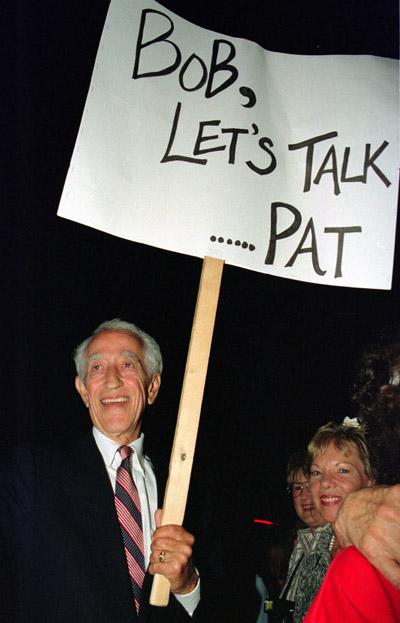
Pat Paulsen asks Sen. Bob Dole to talk

1960’s comedian Pat Paulsen holds a sign asking Sen. Bob Dole to talk during a 1996 presidential campaign stop. (Copyright John S. Stewart/LEFTeyeSTORIES.com)

The issue was not his sign that read, “Bob, Let’s Talk…Pat.” It was the stick on his sign. The Secret Service has a “no sticks” rule when you…anyone, including media…are near a candidate. Sticks of the literal kind like the one on the sign and “sticks” of the tripod kind that photographers use, are banned when in striking distance of the president, vice-president or wannabes.

While the agents were insisting the stick be removed and the man was proclaiming his rights as a citizen, the mood didn’t seem particularly tense. In fact, I thought I could detect suppressed grins on the normally stony faced Secret Service agents.

Who is, “Pat”?

Then it hit me. Pat was the “Pat Paulsen for President” from the 1960’s through the 1990’s. He was a semi-regular on  Rowan and Martin’s Laugh-In and a regular on The Smothers Brothers Comedy Hour that earned him an Emmy in 1968.

I stood back and watched as Pat obediently removed the stick and handed it over to the agent who retreated from the scene. Pat continued with his stick shtick to the delight of the tourists within earshot.

I called out, “Pat…Pat…Pat Paulsen.”

He looked at me and pointed to the bling of media credentials and cameras hanging around my neck and said, “You’re with the press! I need to talk to you.”.

Before he could get started, I urged him to come stand with me in the VIP section explaining that Sen. Dole might work (shake hands) the tourist crowd but would for sure work the VIP area where the moneyed donors were penned up.

For the next couple of hours Pat, his wife Noma and I stood and waited for Sen. Dole to arrive. We talked about his past television experiences and when I asked him about his almost 30 year campaign for president, the straight-faced and never out of character Paulsen said, “I am a serious candidate.” That might not be too far from the truth since he did end up on several states’ primary tickets.
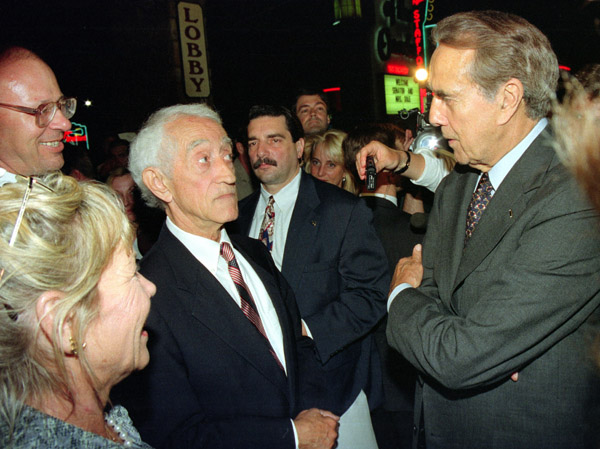
Pat Paulsen and Bob Dole in stare down.

Comedian and tongue-in-cheek presidential candidate Pat Paulsen engages in a stare down with 1996 for real presidential candidate Sen. Bob Dole. (Copyrighted by John S. Stewart/LEFTeyeSTORIES.com)

Finally, the motorcade arrived, the senator stepped out, waved to the tourists and was ushered over to the VIP section. Upon seeing Pat, Sen. Dole said, “Hello. They told me you were in the crowd.” With that, the two assumed sort of “stare down positions” like two boxers sizing each other up at the weigh-in.
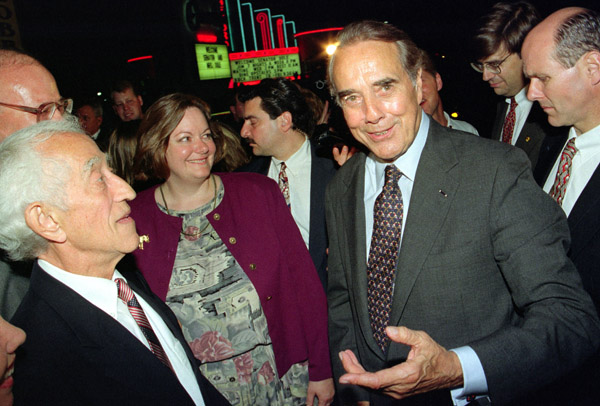
Sen. Bob Dole says, "I don't really know what to say."

After a few moments of staring at each other in silence, Sen. Dole turns to me and says, “I don’t really know what to say.” (Copyrighted by John S. Stewart/LEFTeyeSTORIES.com)

The senator showed he was no match for the king of deadpan when Dole broke the silence turning to me (for whatever reason) and said, “I don’t know what to say.” The two then joked and talked for a few more minutes and called it an evening.
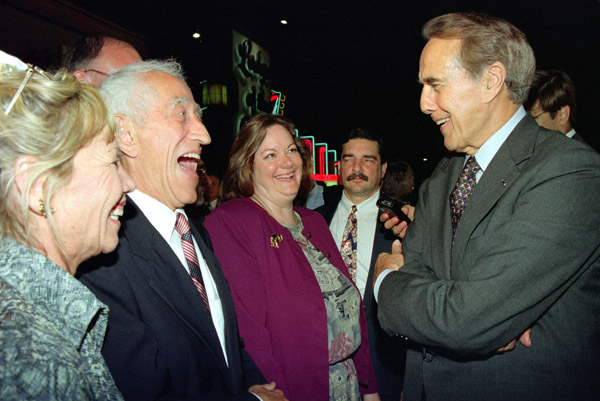
After the stare down ran its course, the normally deadpan Paulsen and usually subdue Dole share a laugh. Paulsen's wife, Noma is at far left. (Copyrighted by John S. Stewart/LEFTeyeSTORIES.com)

After the stare down ran its course, the normally deadpan Paulsen and usually subdue Dole share a laugh. Paulsen’s wife, Noma is at far left. (Copyrighted by John S. Stewart/LEFTeyeSTORIES.com)

Pat provided much-needed comedic relief during sometimes tense election seasons. For me, he provided an evening of entertainment for what is usually a tiring several hours of standing around. We communicated a couple of times after these photos were taken and I sent him the one of  them staring at each other. Unfortunately, Pat passed away from cancer less than a year later.

His gentle humor is missed in a time when so much humor has a sting to it.

John S. Stewart

JSanimated

Death Sentence Commuted: An Epiphany For Me

Death Sentence Commuted: An Epiphany For Me, THE OZARKS

WARNING: No graphic photos but the following does include a graphic description of a crime scene. LEFTeyeSTORIES after all, are those personal experiences…good, bad or ugly…that happen during photo assignments.

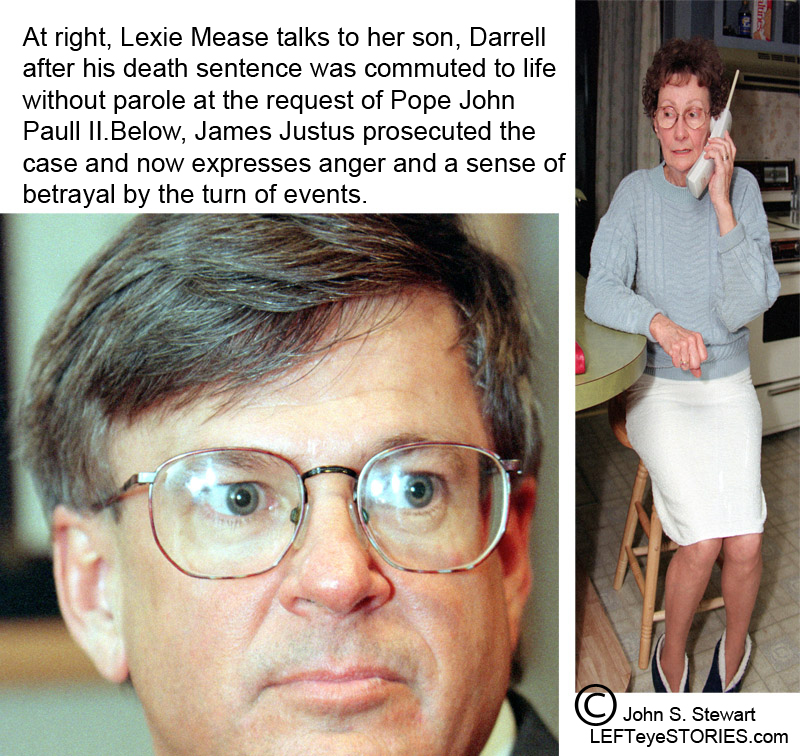
A boy grieves under the stress of the fast approaching day when his father will walk from his prison cell for the last time and put to death by the citizens of the state of Missouri. His schoolmates taunt him with, “Your daddy’s gonna die soon. He’s gittin’ what he deserves, ya know.” A mother sits in her rural Ozarks home reading the Bible, praying and wondering how her son whom she raised in the church, was well liked growing up and had even wanted to become a preacher before serving in the military in Viet Nam, could come to this. A former county prosecutor takes at least some degree of satisfaction as the last chapter of this capital murder case comes to a close. He was successful and successfully prosecuting cases like this helped to advance his career from county prosecutor to Associate Circuit Judge. An ailing and very frail Pope leans forward and whispers a plea in the ear of a Missouri governor and the wheels are put in motion that ultimately put me on the back roads of Taney County Missouri to meet up with some of these folks. The story of how convicted murderer, Darrell Mease ended up on Missouri’s death row reads like a chapter in Daniel Woodrell’s novel, “Winter’s Bone”. While the book does not parallel this particular crime, it does profile the meth culture that pervades so much of the rural Ozarks. Much of the 2010 movie by the same name was filmed in Taney County where Mease lived and committed the triple homicide more than two decades earlier. In 1987, Darrell Mease began working with Lloyd J. Lawrence to manufacture and sell methamphetamine. The relationship soured and Mease left the area, but not before stealing some of the drug. Lawrence made it known he intended to kill Mease so Mease decided to strike first. Mease and a female companion returned to Taney County in May 1988. He formed and then carried out a plan to ambush Loyd Lawrence while Lawrence and his wife, Frankie and their 19-year old paraplegic grandson, William were riding their four-wheeled all terrain vehicles near the Lawrence home. The three were shot as they drove past where Mease lay hidden waiting for the opportune moment. Each was then shot at point-blank in the head with a shotgun. Lawmen followed the trail back to Mease and he was arrested, tried, convicted and sentenced to death by lethal injection. After years of going through the appeals process, a date was set for his execution: February 10th, 1999. During that time, Mease claimed to have undergone a jailhouse conversion even though he had come to accept his destiny on earth. In a letter he wrote, “I had gotten saved when I was ten and backslid when I was 19 and then ran with Satan and his own for many years.” Mease’s original execution date was January 27th but was changed when it was discovered that date coincided with a visit to St. Louis by Pope John Paul II. During that visit, the Pope approached Missouri Governor Mel Carnahan and asked that Mease’s life be spared. The next morning the governor signed an order commuting the sentence to ‘life without parole.’ That’s when photo requests started coming in. News outlets like the Associated Press and the New York Times wanted photos of Mease’s mother, the Taney County prosecutor who put him on death row and any other players. The Pope had requested clemency for other death row inmates in Missouri and in other states, but without success. So, this is suddenly a national news story and I’m on the road to meet reporters from the Times and the AP and Darrell Mease’s mother, Lexie Mease at her house.

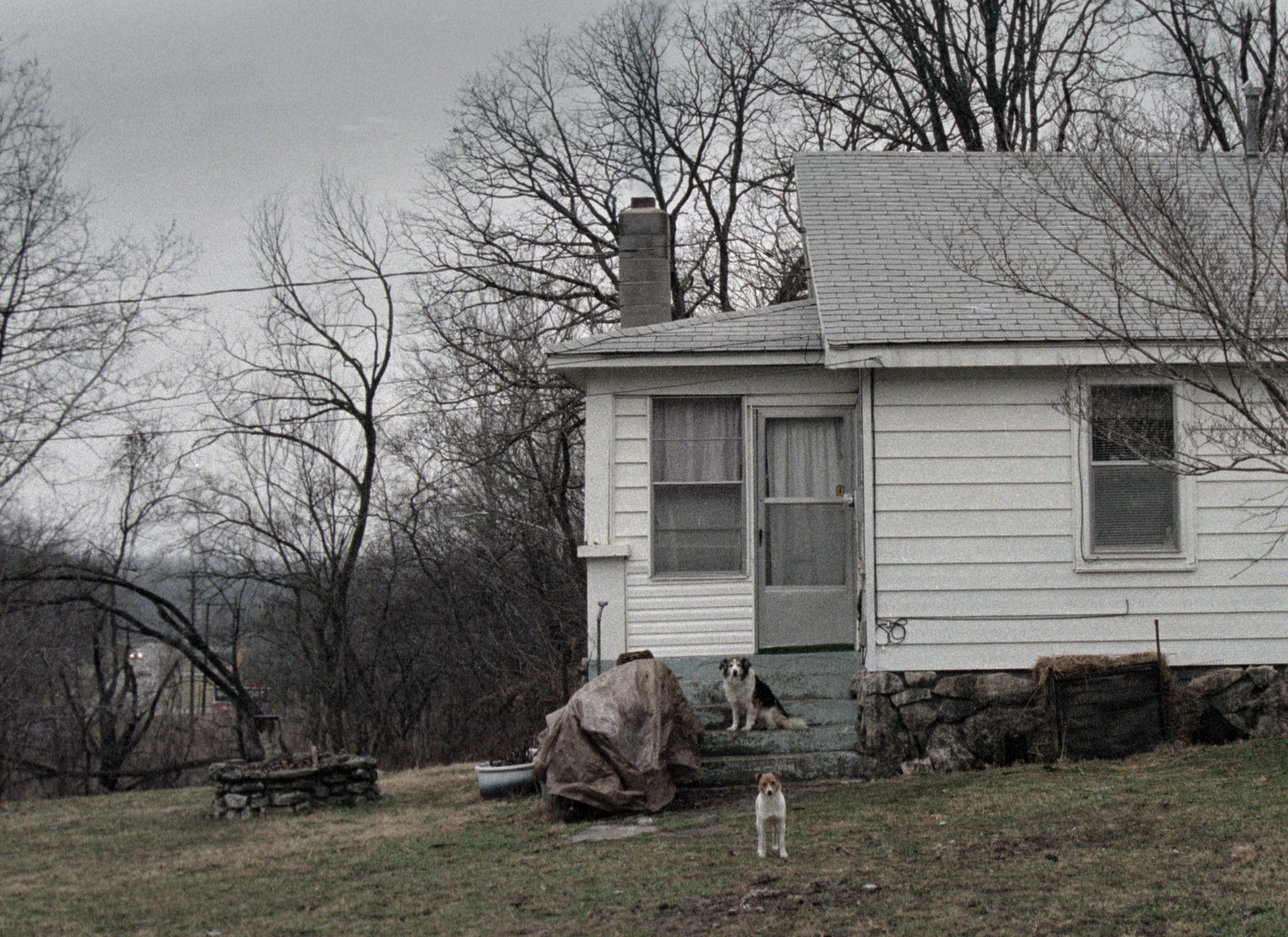
Typical of many rural Ozarks’ homes, Lexie Mease’s home is in Taney County, Missouri. (Copyrighted by John S. Stewart/LEFTeyeSTORIES.com)

Late January in the Ozarks is not particularly picturesque. In fact, most of us who live here are beginning to feel the effects of the gray landscape, gray sky, short days and like today, cold rain that sum up most winters in the Ozarks. As I drove past familiar summer tourist spots and turned on a gravel road, I passed small vacant A-frame shaped chicken coops. I have seen these coops on past trips down this road when each miniature A-frame housed a single rooster tethered to a stake. I am reminded of just how close the family oriented summertime touristy Ozarks and its seedier cock-fighting meth making kin are to each other. The gravel drive up to her house just sort of petered out into an undefined area of parking and yard. Lexie Mease’s house sat at the bottom of a hill with no neighbors close by; not close by like we have in town. I could see a faint ribbon of blue smoke rising from the chimney through the cold windshield wiper drizzle. Two dogs lounging on the front stoop were now on high alert deciding if I was friend or foe. When I am travelling separately from a reporter, I like to arrive a little early. It gives me a chance to get oriented before the reporter/subject conversation moves into high gear. I have less of that, “got in on the middle of the conversation” feel that makes it hard to feel like you are at your best. Lexie answered the door with, “Oh, come in. I just have to finish dressing. I’ll be just a minute.” She was pretty much dressed except for changing out of a terry cloth wrap and house shoes. The small shy, almost timid woman seemed like the type that would bring a plate of cookies over if she knew you were having a bad day. On the wall hung a cross and picture of Jesus. On the table lay a Bible. In the corner near the door was a wood burning stove that are still the primary source of heat in many rural Ozarks homes. “That’s fine,” I said. “I’ll just warm up by your stove. I love the smell of wood smoke and there’s nothing like wood heat.” She looked back, smiled and said, “You know, this has all happened so fast. My grandson, Darrell’s boy, was here but I sent him away. He’s had such a hard time and has been so stressed. The kids at school have been so cruel. I just didn’t think he needed to have to talk to the news people.” Before she made it to the bedroom, the phone rang. “Hello. Yes. Darrell! Yes, honey.” Then to me, “This is Darrell. This is my son, Darrell. This is the first I’ve talked to him since…” Turning back to the phone, “Yes, it’s wonderful. I’m so happy.” Sorry lady. Terry cloth wrap or not it’s picture time. As compelling and dramatic as stories like this are, they are visually slim. They are best told by the wordsmiths with quotes from those involved and as a photographer, you hope to get photos of the people being quoted so the reader can put a face with quotes. When mom talks to her son for the first time since his death sentence was officially commuted, that’s worth a shot. Sometimes it pays to be early. The phone conversation ended and Lexie was euphoric having talked with her son who literally had a new lease on life. The reporter from the New York Times arrived and she began her interview and I took some more photos. It wasn’t long, however, before the mood turned as chilly as the cold drizzle outside. My pre-interview warmup rapport I had established was gone. The little lady I was sure would have brought cookies to my door if I was having a bad day had transformed into the ice queen. In the years since the trial, Lexie Mease had come to terms with the fact that her son had murdered three people. What she had not come to terms with or had just denied it to herself was that it was drug related. When the Times reporter brought it up, Lexie denied it was drugs at the root of the crime. When pressed on the issue, Lexie terminated the interview and invited us to leave. In the meantime, the Associated Press reporter arrived and was waiting outside for his one on one time. He had the awkward task of pleading my case to allow me to stay for photos for him since I wasn’t really with the Times anymore now that the interview was over and that I was with him now and that I was really a good guy. Lexie warmed back up, a little, and I got my photos. Next, I had to make a short drive to Forsyth, Missouri to get a photo of the former Taney County prosecutor who put Darrell Mease on death row. James K. Justus was now Associate Circuit Judge James K. Justus and he did not share Lexie Mease’s joy at having her son’s life spared. Justus greeted me in his office and invited me to sit down at a table. I did so and then with all the restrained anger of a husband who had just found out his wife had cheated on him and had the photos to prove it and wanted to show them in hopes of gaining an ally, he slapped down three crime scene photos one by one in front of me. They were gruesome. Two of the photos showed the bodies of a man and a woman with their heads blown into many pieces spread over several square yards of green grass like smashed watermelons. The third photo showed the body of the 19-year old paraplegic grandson with his legs still tied to the sides of the four-wheeled ATV so he could stay on. It showed his body thrown backward and severe head trauma. I looked at the photos for a time making a concerted effort not to recoil or show any emotion and then looked up at Justus. He said, “Why…why should a person who did this NOT pay with his life? What do you think? Do you have an opinion?” I looked back down at the photos and thought for a moment. Why should he not pay with his life? This is awful. If there were any “innocent victims” of this crime, surely it was the 19-year old or maybe his grandmother. They were obviously killed to make sure there were no witnesses. Then I began thinking about Mease’s own son. He’s a victim. He’s alive. He’s not been shot in the head but still he is a victim of this crime. This will affect him for the rest of his life; but how? That could depend on his father being allowed to live (not go free) or if we, the citizens of Missouri, decide to make Darrell Mease pay with his life. Would that de-victimize anybody or help ease someone’s pain in some sick fashion? Or, will it just create more victims in ways that are not as obvious and may not become clear for many years. I looked back up at Justus and responded, “I’m not really here…to give an opinion. I’m here to take photographs.” He said, “OK. Then let’s do what you’re here to do. Where do you want me?”

John S. Stewart

Link to the Associated Press Story:

http://www.apnewsarchive.com/1999/Mo-Family-Thankful-for-Pope-s-Help/id-cd9c705954dd59861c2f0a0c813fb117

Link to the New York Times Story:

http://www.nytimes.com/1999/01/31/us/clemency-for-killer-surprises-many-who-followed-case.html?pagewanted=print

Link to an NPR  audio interview with Michael Cuneo, author of “Almost Midnight”, a book that  profiles Darrell Mease, the circumstances that lead up to the killings and the Pope’s involvement. 

http://pd.npr.org/anon.npr-mp3/npr/me/2006/08/20060816_me_03.mp3?dl=1

Hey, I’m Alive!…part two

I'm Alive!...part two, QUICK SHOTS

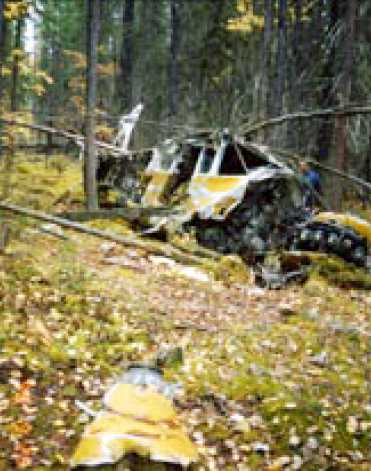
The photo assignment was to drive to a little town in Missouri where a fellow had some pieces of a plane his late father had crashed in 1963. The man was planning to gather more of the plane, rebuild it and fly it.

A question kept coming back to me on the drive up: Why?

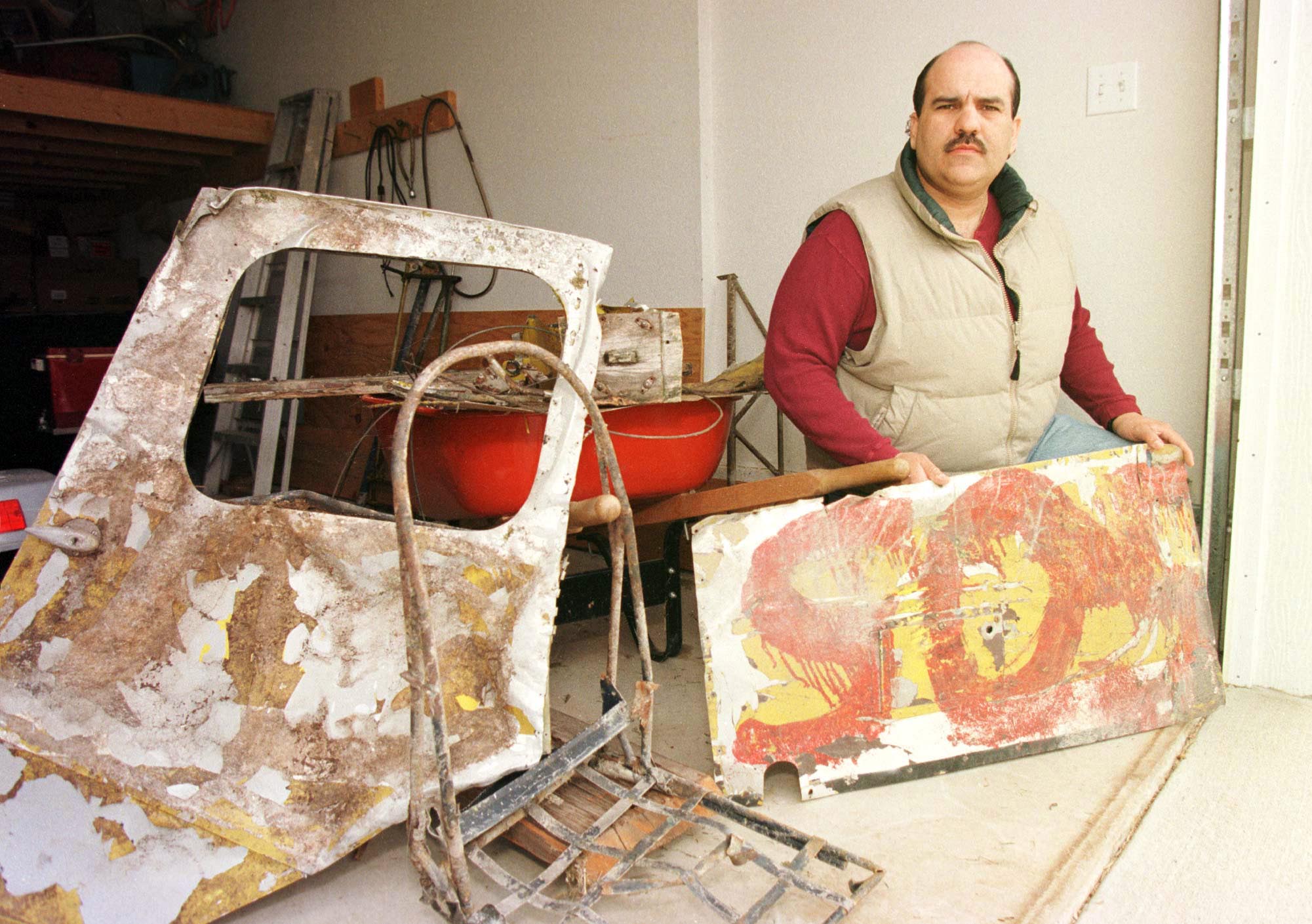
Frank Flores with parts of his father's crashed plane in his Willard, Missouri garage.

Frank Flores holds a sign his father, Ralph Flores used after his plane crashed in the Canadian Yukon in 1963. (Photo by John S. Stewart/LEFTeyeSTORIES.com)

The gentleman I was to meet was Frank Flores whose father, Ralph Flores and a passenger, crashed in the remote Canadian wilderness in the dead of winter. They survived for 49 days with almost no food in subzero temperatures before being rescued.

As Frank Flores recounted his father’s ordeal and his plan to rebuild and fly the plane that was still mostly at the crash site, I began thinking the story sounded familiar. I had seen a movie made a couple of decades earlier based on a book written by Flores’ passenger, Helen Klaben.

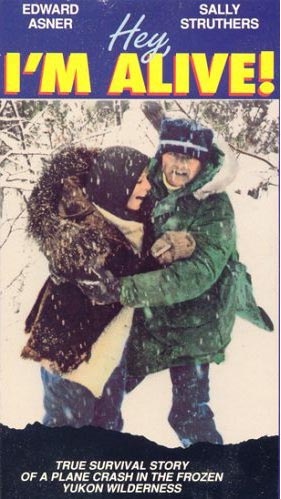
The 1975 made for TV movie starred Ed Asner as Ralph and Sally Struthers as Helen and was, in my humble opinion, just so-so. The story, as Frank told it, was fascinating. Maybe I’ll read the book if it is still in print.

The “Why?” of this “part two sequel” was still unclear. Why go to all the trouble and cost to rebuild a crashed plane and then fly it after all these years? The answer was it was an unfulfilled promise the younger Flores had made to his father who had passed away a year earlier.

But, still I wondered, “Why”?

You can read a 1963 two part newspaper story about the crash and rescue with photos of Ralph and Helen here:

http://www.whitehorsestar.com/History/hey-im-alive-part-1

http://www.whitehorsestar.com/History/hey-im-alivepart-2

You can read the story of Frank’s attempt to collect and rebuild the plane in this 1999 LA Times story here:

http://articles.latimes.com/1999/jan/24/news/mn-1218

I couldn’t find any followup story so I doubt Frank finished restoring the plane. If that is the case, that’s a little sad but predictable. At the time, Frank seemed like he was heavily grieving the loss of his father which can skew rational thinking.

Here is a link to another blog post related to this story: http://www.gadsdentimes.com/article/20101226/WORK/101229935?p=1&tc=pg

And, here is a photo (photographer unknown or I would gladly credit) of the plane as it sat in 1998 where it crashed more than 30 years earlier.

RalphFloresPlane1998

John S. Stewart

JSanimated

MISFIRE!

FAMOUS PEOPLE, MISFIRE!

Unlike fishermen, photographers usually don’t like to talk about “the one that got away”.  But, I have decided to swallow my pride and add my story of the one that got away to the LEFTeyeSTORIES files.

In the summer of 1993, the midwest was drowning in what was being called a hundred-year flood. Seeing an opportunity to help as well as an opportunity for some feel-good public relations,  country music tourist destination Branson, Missouri, decided to have a fundraiser in the form of a nationally televised telethon.

Anyone who was anyone in the entertainment business (and many in the “Who?” category) showed up in B-town wanting to do their part and get a little face time on national television. This included billionaire Ross Perot, who had just the year before made an unsuccessful bid for president.

I was there working for The Ozark Marketing Council and a couple of publications. I was also hoping to sell a few other photos on speculation.

Bob Hope was scheduled to be up next. I had already seen him backstage and he looked very frail so I was thinking that I better get shots of him because there may not be another opportunity. Then a hand on my shoulder and a whisper in my ear told me of another plan.

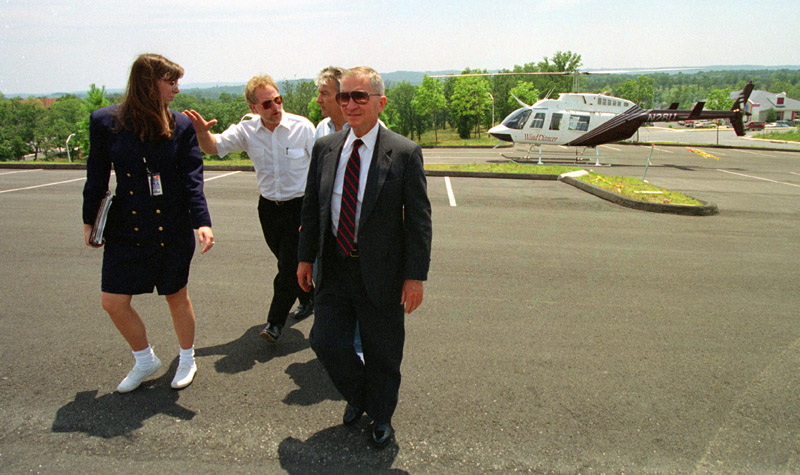
A happy-go-lucky Ross Perot walks from his chartered helicopter at the Grand Palace in Branson, Missouri. Following are Beth Wanser, the pilot and an aid of Perot. (Copyright John S. Stewart/LEFTeyeSTORIES)

Beth Wanser of the Ozark Marketing Council was telling me that Ross Perot was sitting in his chartered helicopter outside the theater and was going to fly to the Grand Palace to meet country singer Billy Ray Cyrus who was still riding the wave of  his big hit, “Achy Breaky Heart”. There was one seat left on the helicopter and I could have it but we had to go now.

From the theater where we were to the Grand Palace is about a mile and a half, if that far. The problem was the traffic. It would have easily taken an hour by car so the helicopter was a good option.

Beth and I made our way past a few other glaring photogs and TV videographers to the helicopter that was already warming up with rotors turning. I headed to the copilot’s door thinking that’s probably where the vacant seat would be. Instead, the door popped open and that distinctive head with those distinctive ears spoke in that distinctive high-pitched Texas drawl that could be heard in spite of the noise and whirling blades above,  “Son, you ride in the back. I’ve got it up here.” So I got in.

Five minutes later we were on the ground behind the Grand Palace. A waiting van whisked us the remaining 100 yards to the backstage door. Perot was particularly jovial. “Son, where do you need to sit with all your equipment?” and “Son, you go on ahead if you need to. You need to get the pictures.”

When we got to the backstage door, Beth led the way through a maze of cables, equipment and stage hands to the green room which normally would have been filled with performers waiting to go onstage. For now it was the place where Beth had arranged for Perot to meet with Billy Ray Cyrus.

Just before we entered the green-room door, one of Beth’s colleagues pulled her aside. Perot continue on into the green-room and I followed, raising my camera in anticipation of  the pending Ross Perot/Billy Ray Cyrus hug-fest.

The room was large, furnished with chairs and coffee tables filled with finger food for the performers. It was also completely empty. Perot and I  stood there for a moment; Perot staring straight ahead and me staring at his back. I lowered my camera and in that instant, he spun on his heel and looked straight at me.

The happy-go-lucky, former presidential candidate I walked in with had transformed into a scowling Elmer J. Fudd. All that was missing was the steam coming out of his ears.

An unhappy Ross Perot

A less than pleased Ross Perot makes his way out of the "green room" backstage at the Grand Palace after being stood up by Billy Ray Cyrus. Beth Wanser (L) and Lisa Rau (R) stand aside. (Copyright John S. Stewart/LEFTeyeSTORIES)

And there it was, the missed shot: Ross Perot standing with hands on hips looking straight at me and anger oozing from his pores. It was perfect; I had a wide-angle lens to capture the empty room behind him and since I’m a head taller than him it was a great angle. The only problem was that my camera, now hanging around my neck,  might as well have been a concrete block sitting at my feet because I couldn’t get it back up to my face fast enough before he shot past me towards the door spewing, “MISFIRE! MISFIRE!”

Like an angry warrior spraying the room with machine gun fire, he shot in rapid succession at nobody in particular, “THAT’S WHAT THIS IS, IT’S A MISFIRE AND WHAT YOU DO WHEN YOU HAVE A MISFIRE IS YOU JUST GO ON, SO THAT’S WHAT I’M GOING TO DO. I’M GOING TO GO ON BECAUSE THAT’S WHAT THIS IS, IT’S A MISFIRE!!”

Ross Perot is a smart man and not used to being stood up. He figured it out really fast. I had to get the news from Beth Wanser and Lisa Rau, director of public relations for Silver Dollar City (who owned the Grand Palace at that time) and co-owner Peter Herschend who had all huddled together trying to calm Mr. Perot down.

In the five minutes it took to fly to the Grand Palace, Billy Ray Cyrus’ people had decided it would not be a wise thing for the singer to be photographed hugging, shaking hands or even standing next to the then still politically hot Ross Perot. It might alienate some of Billy Ray’s fans.

So, Ross Perot’s “Misfire” became my “Misfire”. End of story, almost.

Years later Lisa Rau and I were talking about the misfire photo-op and she said, “Let me tell you about the rest of my day that day.”

She went on to tell me that she was assigned to drive Billy Ray around Branson and let him see the sights. One of the things he wanted to do was go to the Factory Outlet Mall and buy some shirts. So she took him to a store using the back door while the store manager politely asked the shoppers (mostly women) to step outside for a few minutes. The manager then locked the door.

With the store secured, Billy Ray walked onto the sales floor and wasting no time, stripped off his shirt.  He then began trying on shirt after shirt leaving the unwanted ones on the floor. All the while, the displaced female shoppers pressed their faces against the store’s windows and squealed with delight.

After he made his final selections and checked out, Billy Ray was ushered out the back door. The store manager then unlocked the front doors and the ensuing scene resembled  something like a miniature Black Friday shopping frenzy. The female shoppers were scrambling to pick up and purchase all the shirts he had tried on and left on the floor.

Happy shoppers. Happy store keeper. No memorable photo…but that’s OK; it makes for a good dinner story now and then.

John S. Stewart

Andy Williams-A Class Act

Andy Williams-A Class Act, FAMOUS PEOPLE
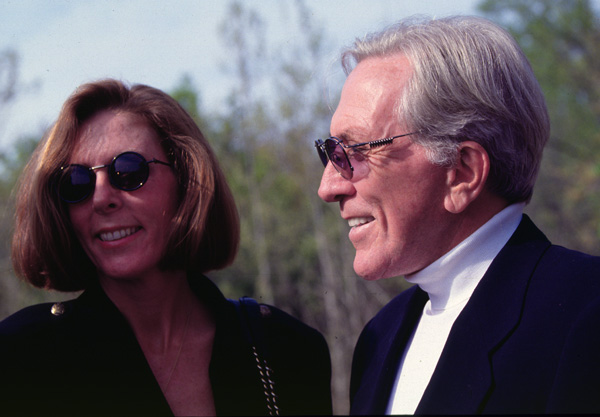
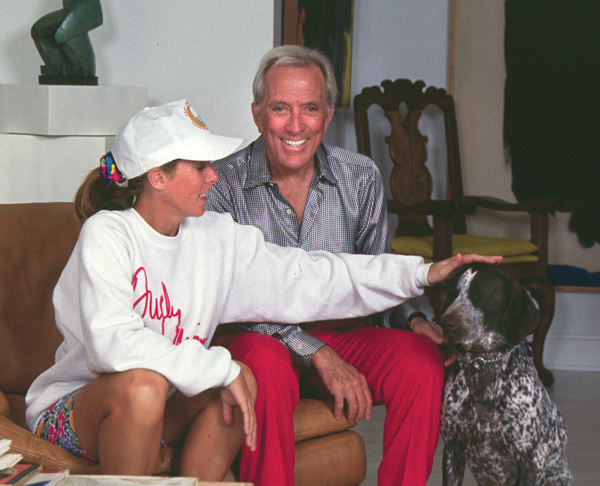
Debbie and Andy Williams

Andy and Debbie Williams.

Celebrity for the sake of “celebrity” has never had much appeal to me. I think that’s a plus when photographing famous or nearly famous personalities in one on one photo sessions.  It sends a subliminal message of, “I’m not here to stroke your ego” and lets them know that the annoying  “star stuck fan” is not in the room.

Honestly, I’m not very knowledgeable when it comes to who’s who and who did what in the show biz world. I let the reporter on the assignment do that homework. Some of these folks have egos so large it was difficult being in the same room with them and others were actually humble and interesting to talk to. But then, that’s like it is in the non-celebrity world. Right?

In a word (or two), Andy Williams is the epitome of class, good taste but also personable and seemingly in touch with the real world.

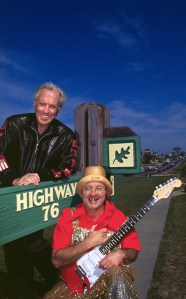
In the ten or so photo shoots I have had with him, he never tried to control the shoot and was open to and tried to accommodate ideas I had. He was game when I wanted to hire a flatbed truck so he and “Herkimer” (Gary Presley) could stand next to a Highway 76 road sign some nine or ten feet in the air.

Andy Williams and "Herkimer" (Gary Presley) pose for a magazine cover on 76 Country Music Blvd. in Branson, Missouri.

Andy Williams and “Herkimer” (Gary Presley) pose for a magazine cover in Branson, Missouri.

The photo shoot was for a travel magazine cover that was to illustrate the two flavors of live entertainment in Branson, Missouri. Everything was in place. The truck was in place next to the sign. Camera, lights and Herkimer were all in place. With exposure readings taken and camera adjustments made, Andy drove up from a feeder road to 76, rolled down his window and said, “We’re going to have to make this fast.” Pointing to the traffic on 76 and tourists on foot he expressed some concern.

He was right, but we got through the shoot. Within two or three minutes after Andy climbed up on the truck, traffic on Highway 76 began to stop. Car doors opened in the middle of the road and tourists with cameras in hand began crowding around the truck. Within another minute, I had helped him off the truck and he was back in his car headed to  his theatre.

The whole shoot was over in less than five minutes with fewer than 20 frames of a 120mm roll of film exposed but the editors were able to select one for the cover.

andywilliams-debbie-and-sophie-1

Andy and Debbie Williams and Cody, a German Short-Hair Pointer, share a moment in the Moon River Theater apartment where he relaxes between shows.

Most  other photo shoots were in or around the more crowd controllable setting of his Moon River Theatre or his spacious apartment/dressing room and adjoining courtyard at the theatre. His wardrobe closet is larger than some dressing rooms I’ve seen and is meticulously arranged with shirts, pants and of course sweaters of the same design grouped together.

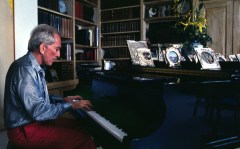
Andy Williams at the piano

Andy Williams at his dressing room piano.

In the main part of the apartment is a grand piano with framed photos of family and friends. One of them was from friend Robert F. Kennedy. It was a photo I had seen before of Kennedy, his wife Ethel and all their children lined up in front of their Hickory Hill home. Kennedy had written on it, “Andy, If you take Ethel, you have to take the kids. Bobby”.

Andy recounted how he and Kennedy met and Kennedy asked him to join his campaign for president. Andy told him he would be glad to but that there was a problem because he (Andy) was a registered Republican. He said Kennedy responded, “Oh, that’s not a problem. We can fix that.” Later that year in the early summer of 1968, Andy would sing “The Battle Hymn Republic” at Kennedy’s funeral.

A few weeks later at another photo shoot in his theatre apartment I noticed the photo was gone. I asked Andy about it and he kind of mournfully opened a drawer where the photo, torn in several places but still in the frame, lay with the glass shattered. He explained that one of his grandchildren had dropped it and over the years the photo had become stuck to the glass causing the photo to tear. Even big stars have those everyday “Dang it!” moments.

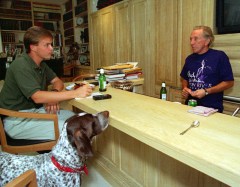
Sophie and Andy at the wet bar

Andy cleans up after a lunch interview as Cody waits for table scraps.

Interviews with photo shoots were usually scheduled to run over the noon hour after his morning round of golf and before the afternoon performance. That meant it was sometimes a lunch interview with lunch at his wet bar in his dressing room and almost always accompanied by Sophie, one of his favorite and really friendly German Shorthair Pointers. And that was a good thing.

After you have passed Sophie’s head to toe sniff test which is just a dog’s way of getting to know you, she makes a great photo prop…someone for Andy to interact with…a new element in the mix.

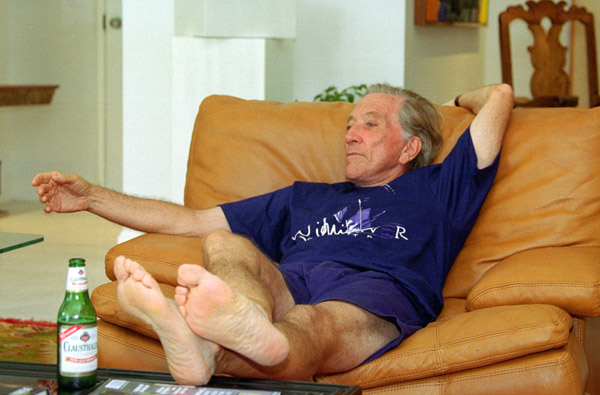
Andy Williams relaxing in his Branson, Missouri Moon River Theatre dressing room after a round of golf.

Andy Willams relaxes in his Moon River Theatre dressing room after a round of golf.

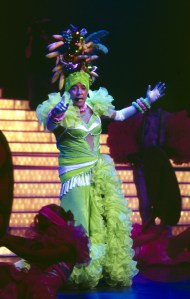
Andy Williams as Carmen Miranda at his Moon River Theatre in Branson, Missouri. (Photo Copyrighted by John S. Stewart/LEFTeyeSTORIES)

Andy Williams shows his sense of humor with a stage performance as Carmen Miranda.

Every shoot I have had with Andy Williams has yielded some of the most relaxed images of any entertainer I have photographed. This even applies to those couple of times a reporter failed to tell his staff ahead of time there would be a photographer along.  That serves as a testament to him being comfortable in his own skin and OK with the moment at hand which probably has something to do with his career’s longevity. That and keeping those golden pipes healthy all these years.

John S. Stewart