
A Biker’s Funeral

A Biker's Funeral, PHOTO STORIES, THE OZARKS

“Well, you sure have some pretty rough, scruffy lookin’ friends”, the office secretary shot across her desk as I came through the door of the small Missouri town newspaper where I worked in 1978.

Booger Red's friends escort him to his final resting place.

Friends of “Booger Red” line up for the funeral procession that will take him to his final resting place. “Hagen” is at right in the German helmet. (Photo copyrighted by John S. Stewart/LEFTeyeSTORIES)

Twenty minutes earlier, the office was full of a dozen or so leather jacketed tattooed (tattoos weren’t so mainstream then) motorcycle gang members wanting to see me. Their friend and fellow gang member, “Booger Red” had been ‘murdered’ and now they were going to bury him with a proper biker’s funeral.

Some weeks earlier I had taken a photo of a local teenaged boy being airlifted to a Shriners’ Burn Hospital after he ignited himself  with gasoline while filling up his motorcycle. His father, “Hagen” was the gang’s leader and wanted me to photograph their friend’s funeral. I was to go to his house where the gang had gathered and we would talk about it. O…K….sure why not?

Motorcycle gang member "Booger Red" at the funeral home the night before the biker's funeral.

Motorcycle gang member “Booger Red” at the funeral home the night before his biker funeral. (Photo Copyrighted by John S. Stewart/LEFTeyeSTORIES)

Booger Red got his name from his flaming red hair and by his friends’ own description, he was a “booger”…mean. He was killed by a single gunshot to his chest through a screen door after he threatened the person inside with an ax during a drug deal gone bad. I was not going to argue with his friends whether he was “murdered” or killed in self-defense.

I arrived at Hagen’s house and was greeted in a quiet way like anyone arriving at a wake. The group, dressed in leathers accented with chains and images of skulls and fire was somber.

Years later while visiting an Amish household I would remember the

Mounted on their hogs, friends of Booger Red line up outside the funeral home.

Mounted on their hogs, friends of Booger Red line up outside the funeral home. (Photo Copyrighted by John S. Stewart/LEFTeyeSTORIES)

similarities in the two experiences. None of the men, except the leader, would talk to me. When I made eye contact with the female members of the group, they would look away.

Hagen and I sat a table and he thanked me for coming and then outlined the next day’s funeral activities. There would be a traditional funeral at the local funeral home for “Booger’s” immediate family. Yes, Booger actually had a mother and siblings. After that, it was the gang’s show. There would be a motorcycle escort the fifteen miles to the grave site out in the country and graveside services.

Hagen went on to explain that after that at most biker funerals,  everyone stands around and drinks beer and puts their empties into the casket. Charming. That would not happen for Booger Red. The celebration would wait until that evening when there would be dancing and drinking ON his grave. There would also be a couple of vans parked there with a girl in each …there for the taking. Thanks but no thanks.

At this point a whirl wind of journalist ethics, morals and questions began spinning in my head. Do I even continue pursuing this story? It was unusual to have been granted such access without a great deal of rapport but was my presence as a journalist guiding the behavior of the subjects?

The day of the funeral was cold, rainy with a little sleet and snow mixed in. The procession would be stopped several times as biker after biker

Mourners at fellow motorcycle gang member, Booger Red's funeral.

Mourners at fellow motorcycle gang member, Booger Red’s funeral. (Photo Copyrighted by John S. Stewart/LEFTeyeSTORIES)

slid out on the slick pavement ending up on the ground in front of the hearse.

I didn’t go to the evening activities after the graveside services. Instead, I developed film, printed photos and worked on a full-page layout to present to the editor the next day. He went for it and it would run in that afternoon’s paper. Before the presses started to roll, one of the pressmen asked me, “How many extra copies do you want to run?” “Extras?” I replied. “That’s not my decision but I don’t think we’ll need any.” He assured me there would be a need and by six o’clock that evening he was pulling early run rejects (those first copies that come off the press before they have the ink adjusted correctly) out of the trash to put out in the now sold out boxes on the street.

The next morning the office secretary that had remarked about my rough-looking friends locked her eyes on me as I came in and said, “Do you know how many phone messages I have listened to this morning about your biker funeral story and I’m not even to the end of the tape?”

The break was about 50-50. Half  the readers loved it and half hated it

but everybody wanted to read about it. Some saw it as glorifying a seedy element of society and others were interested in getting a glimpse of a side they ordinarily would never see.

To me, that is why you do stories like this one.

John S. Stewart

Frozen Forms

Frozen Forms, QUICK SHOTS

This ballet on ice was actually shot by my father. I say that because he is the one holding the flash and the one who fired it, albeit on my command.

Driving around one winter evening in 1976, I came upon the lake in the subdivision that was a favorite for ice skating in the winter. This evening the skaters were mostly without skates; just running and sliding arms flailing  in the air. It had all the grace of a poorly choreographed ballet with jerky movements.

Skaters on a frozen pond are “frozen” with a handheld flash. (Copyright John S. Stewart)

I thought in stop action it might have a more aesthetically appealing look and make a stand alone weather shot for one of the wire services.

Enlisting the help of dad, I instructed him to stand on the bank of the lake with one of my Honeywell strobes  keeping it pointed at me while I slid out among the skaters.  I set the camera on a tripod, stopped down to about f8 or f11 and opened the shutter with the long gone “B” or “bulb” setting.

I then waited for “the moment” to flash a small penlight flashlight sending my father his cue to fire the flash.  After several times of repeating this anticipating the delay between the cue and the flash and replaying the frozen image in my mind, I was confident I had something useful on film.

Getting this shot today would be a little easier using a digital camera with the ability to check each shot and a strobe  fired using a radio frequency remote. But then, I would have missed out on some quality time with Dad.

John S. Stewart

MANHUNT

MANHUNT...but without the Hollywood ending, PHOTO STORIES, THE OZARKS

Initially, the photos appear to portray a scene from a movie about mid-20th century manhunt in the rural America where racist white officers and their dogs pursue, shoot, and then celebrate the capture of a young Black man.

This was not the case here. I know. I was there. This is where proper words have to fill in the blanks of those 1000 word essays that photos are supposed to deliver.

Minutes after firing a single rifle shot that ended the flight of fugitive Willie Joe Taylor, the sharpshooter kneels at his side.

Minutes after firing a single rifle shot that ended the 3-day flight of fugitive Willie H. Taylor, the sharpshooter kneels at his side.

In October 1977, Oklahoma murder suspect and fugitive Willie H. Taylor was taken in to custody in Pulaski County, Missouri. During questioning, he grabbed a deputy’s gun, wounded the deputy, and fled in a stolen truck.

Two days later, Taylor ditched the truck in Camden County and continued his escape on foot through the rugged Ozarks countryside. The ex-marine had his shoes removed during his arrest, but that didn’t seem to slow him down.

Sightings of Taylor by residents of the hill country were many. Doors were locked and guns kept close by as lawmen pursued, but always  just one step behind. According to several reports, when confronted by residents checking outbuildings, Taylor would growl and flee instead of speaking.

On the third day, I got word through an informed source that “today could be the day they get him.” The focus of the manhunt was now in a wooded area in Camden County. Many law enforcement vehicles and officers, including the FBI, were parked along the road near the command center. Amazingly, there were only two TV crews and one radio station there. I was the only still photographer.

Dogs track fugitive Willie Joe Taylor over the rugged Ozarks' terrain in south central Missouri.

Dogs track fugitive Willie H. Taylor over the rugged Ozarks’ terrain in south central Missouri.

Events like this were a lot less formal in 1977 than they are today. Maps were spread out across the trunk of a patrol car and if you weren’t too intrusive, you could listen in on the discussion. Today those conversations are locked inside a mobile command unit van and media updates are issued regularly.

On this day, law enforcement officers even shared their hot coffee in Styrofoam cups to fend off the icy drizzle that made everyone all the more hopeful for a quick end to the manhunt. Within 30 minutes of my arrival, that hope came as several more vehicles arrived loaded with police tracking dogs from Indiana and Ohio. They happened to be training at a police K-9 school 70 miles away in Strafford, Missouri.

Until now, one or two privately owned “bloodhounds” had been used without success. Their primary “day jobs” were running raccoons up trees during those fabled Ozarks coon hunts and keeping their owners warm on cold winter nights. The task exceeded their abilities.

The newly arrived training school dogs were let out of their cars. Handlers were briefed at the back of a squad car. Then, disappearing over a nearby ridge, we began hearing the rapid chorus of barks that seemed to say, “we’re on to him.”

No one spoke. We couldn’t see what was happening on the other side of the ridge other than what was conjured up in our minds. The sound of the dogs’ excitement moved across the vista in front of us as everyone’s head panned right to left.

And then, muffled by the damp terrain of the ridge, boom…boom, boom, boom, boom…………………….boom.

Still, no one spoke. Coffee cups dropped to the ground and a rush to the cars followed. Lawmen and media drove a short distance up the road until we came to a drive with a closed gate where we left the cars to continue on foot. We ran past a house whose occupants stood watching wide-eyed and mouths hanging open as we scrambled over their barbed wire fence and continued up the hill.

A 3-day manhunt for fugitive Willie Joe Taylor ended with Taylor lying on the ground shot and his shooter kneeling beside him surrounded by a dozen or more lawmen.

The manhunt for fugitive Willie H. Taylor ended with Taylor lying on the ground shot and surrounded by law officers.

At the top of the hill, I stopped to click off a few shots of what I saw in the field in front of me. Lawmen surrounded a figure lying on the ground with another figure kneeling beside him. We learned later the first shots we heard were gunshots fired into the air, attempting to get Taylor to stop after the dogs had flushed him out of the woods. Officers also yelled at Taylor from across the field to stop. The dogs remained on their leashes, unlike some movie depictions.

When he didn’t stop, the last shot was fired by a young Missouri Water Safety officer, Gary Barclay. The sharpshooter who took time to get into a sitting position on the ground to improve his aim. Using the scope atop his high-powered rifle, Barclay took aim at Taylor’s legs. A single shot shattered Taylor’s femur, dropping him to ground and rendering him unconscious.

The Missouri Water Patrol sharpshooter (center) kneels at a fugitive's side minutes after felling him with a single shot from across a field.

Missouri Water Safety Officer Gary Barclay (center), kneels at the fugitive’s side minutes after felling him with a single shot in his leg. Taylor’s torn socks are from his shoeless escape into the Ozarks’ countryside.

I ran up to the scene and dropped to my knees a few yards from Taylor’s feet. I remember seeing the scene in front of me, but being so out of breath, I worried I wouldn’t be able to hold the camera still enough to record it on film.

Taylor’s socks were in shreds from three days on the run without shoes. Kneeling beside him was the Missouri Water Safety officer, Gary Barclay, who shot him. This was the “non-movie script” ending. Barclay was emotionally drained, if not distraught.

Lawmen catch a ride from the field where Willie Joe Taylor fell.

Lawmen catch a ride from the field where Willie H. Taylor fell.

Other officers, older and more experienced, put their hands on his shoulder as if to comfort rather than congratulate. The atmosphere was somber as they waited for paramedics to arrive. Few, if any, of them had felt what he was feeling now.

Even though Taylor will survive, the emotional trauma the officer felt ran deep. No amount of hunting squirrels and deer that honed his skills as an expert marksman could prepare him for shooting another human, no matter what that human had done. That’s the part you don’t get in the movies.

John S. Stewart

One Face in a Sea of Camouflage

One Face in a Sea of Camouflage, QUICK SHOTS
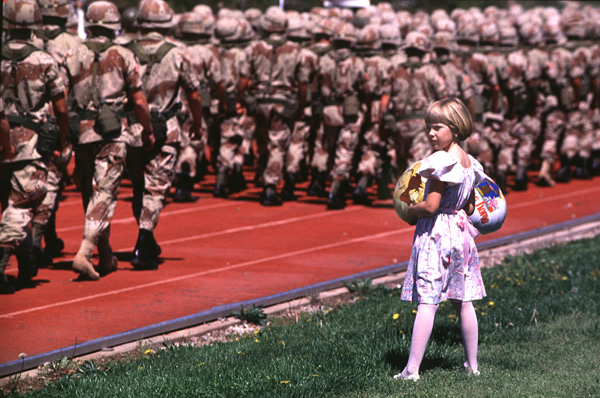
A little girl looks for her uncle in a sea of desert camouflage.

A little girl looks for her uncle in a sea of desert camouflage as troops return home following the first gulf war. Photo copyrighted by John S. Stewart

Following the end of the very brief first gulf war in 1991, troops returned home amidst much fanfare, flag waving and generally a full-blown heroes’ welcome.  The common photo of the day was one of desert tan painted troop trucks lined up on the highway with people standing at the side cheering and waving.

On this day, the troops marched onto a parade field a Ft. Leonard Wood, Missouri to the cheers of friends and family and one little girl who broke ranks with the civilians and ran to the center of the field.

She seemed perplexed and even disappointed. I asked her who she was looking for and she replied, “My uncle”. There were several hundred troops on the field.

Following the welcome home speeches and dismissal, I lost track of the little girl and never got the follow-up shot I hoped for of she and her uncle reuniting. It was surely a special moment but wasn’t to be mine.

John S. Stewart
Al Gore Stumps from a Block

Al Gore Stumps From a Block, FAMOUS PEOPLE, QUICK SHOTS

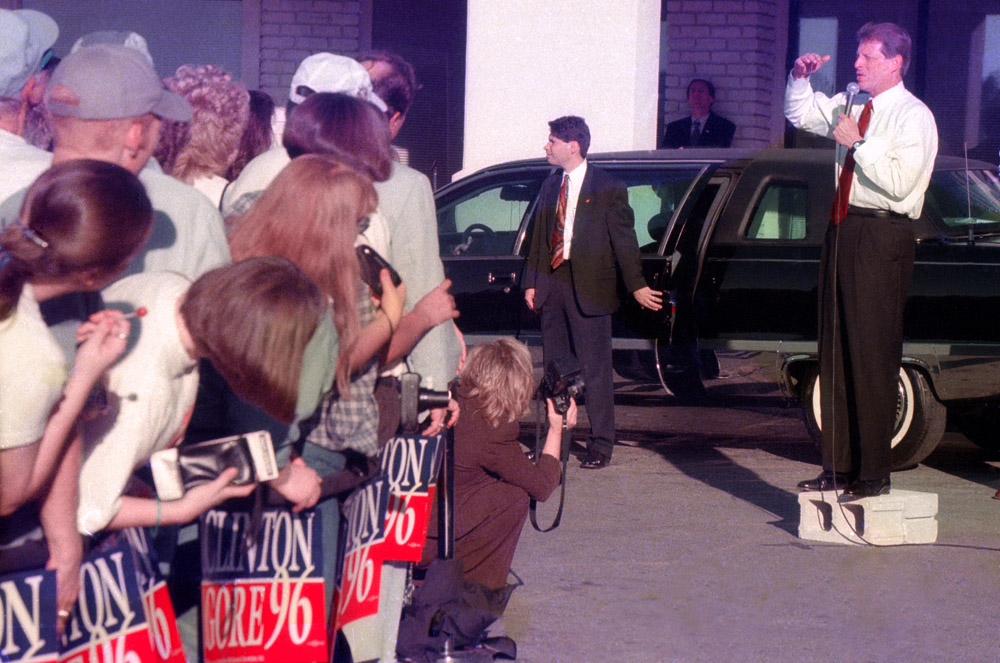
What do you do when your candidate needs to give a “stump speech” and there’s not the usual platform nor even a plain old “stump” to be had on a shopping center parking lot? Grab a couple of concrete blocks, of course! That’ll work.

Al Gore gives a stump speech from a concrete block

VP candidate Al Gore delivers a "stump speech" from a concrete block during a 1996 campaign stop in Springfield, Missouri. (Copyright John S. Stewart)

That’s what happened during this October 1996 campaign stop in Springfield, Missouri. It provided a break from the usual, “look for great facial expression while he’s talking” shot or maybe something with the candidate pressing the flesh in the crowd.

The trick was to get the crowd in the shot as well as the concrete blocks and not have the blocks so small they are barely visible.  A wide lens would have reduced them to a small white speck under his feet. The solution: move way back with a long lens and get as much gray asphalt around the blocks as possible.

John S. Stewart