

MANHUNT

MANHUNT...but without the Hollywood ending, PHOTO STORIES, THE OZARKS

Initially, the photos appear to portray a scene from a movie about mid-20th century manhunt in the rural America where racist white officers and their dogs pursue, shoot, and then celebrate the capture of a young Black man.

This was not the case here. I know. I was there. This is where proper words have to fill in the blanks of those 1000 word essays that photos are supposed to deliver.

Minutes after firing a single rifle shot that ended the flight of fugitive Willie Joe Taylor, the sharpshooter kneels at his side.

Minutes after firing a single rifle shot that ended the 3-day flight of fugitive Willie H. Taylor, the sharpshooter kneels at his side.

In October 1977, Oklahoma murder suspect and fugitive Willie H. Taylor was taken in to custody in Pulaski County, Missouri. During questioning, he grabbed a deputy’s gun, wounded the deputy, and fled in a stolen truck.

Two days later, Taylor ditched the truck in Camden County and continued his escape on foot through the rugged Ozarks countryside. The ex-marine had his shoes removed during his arrest, but that didn’t seem to slow him down.

Sightings of Taylor by residents of the hill country were many. Doors were locked and guns kept close by as lawmen pursued, but always  just one step behind. According to several reports, when confronted by residents checking outbuildings, Taylor would growl and flee instead of speaking.

On the third day, I got word through an informed source that “today could be the day they get him.” The focus of the manhunt was now in a wooded area in Camden County. Many law enforcement vehicles and officers, including the FBI, were parked along the road near the command center. Amazingly, there were only two TV crews and one radio station there. I was the only still photographer.

Dogs track fugitive Willie Joe Taylor over the rugged Ozarks' terrain in south central Missouri.

Dogs track fugitive Willie H. Taylor over the rugged Ozarks’ terrain in south central Missouri.

Events like this were a lot less formal in 1977 than they are today. Maps were spread out across the trunk of a patrol car and if you weren’t too intrusive, you could listen in on the discussion. Today those conversations are locked inside a mobile command unit van and media updates are issued regularly.

On this day, law enforcement officers even shared their hot coffee in Styrofoam cups to fend off the icy drizzle that made everyone all the more hopeful for a quick end to the manhunt. Within 30 minutes of my arrival, that hope came as several more vehicles arrived loaded with police tracking dogs from Indiana and Ohio. They happened to be training at a police K-9 school 70 miles away in Strafford, Missouri.

Until now, one or two privately owned “bloodhounds” had been used without success. Their primary “day jobs” were running raccoons up trees during those fabled Ozarks coon hunts and keeping their owners warm on cold winter nights. The task exceeded their abilities.

The newly arrived training school dogs were let out of their cars. Handlers were briefed at the back of a squad car. Then, disappearing over a nearby ridge, we began hearing the rapid chorus of barks that seemed to say, “we’re on to him.”

No one spoke. We couldn’t see what was happening on the other side of the ridge other than what was conjured up in our minds. The sound of the dogs’ excitement moved across the vista in front of us as everyone’s head panned right to left.

And then, muffled by the damp terrain of the ridge, boom…boom, boom, boom, boom…………………….boom.

Still, no one spoke. Coffee cups dropped to the ground and a rush to the cars followed. Lawmen and media drove a short distance up the road until we came to a drive with a closed gate where we left the cars to continue on foot. We ran past a house whose occupants stood watching wide-eyed and mouths hanging open as we scrambled over their barbed wire fence and continued up the hill.

A 3-day manhunt for fugitive Willie Joe Taylor ended with Taylor lying on the ground shot and his shooter kneeling beside him surrounded by a dozen or more lawmen.

The manhunt for fugitive Willie H. Taylor ended with Taylor lying on the ground shot and surrounded by law officers.

At the top of the hill, I stopped to click off a few shots of what I saw in the field in front of me. Lawmen surrounded a figure lying on the ground with another figure kneeling beside him. We learned later the first shots we heard were gunshots fired into the air, attempting to get Taylor to stop after the dogs had flushed him out of the woods. Officers also yelled at Taylor from across the field to stop. The dogs remained on their leashes, unlike some movie depictions.

When he didn’t stop, the last shot was fired by a young Missouri Water Safety officer, Gary Barclay. The sharpshooter who took time to get into a sitting position on the ground to improve his aim. Using the scope atop his high-powered rifle, Barclay took aim at Taylor’s legs. A single shot shattered Taylor’s femur, dropping him to ground and rendering him unconscious.

The Missouri Water Patrol sharpshooter (center) kneels at a fugitive's side minutes after felling him with a single shot from across a field.

Missouri Water Safety Officer Gary Barclay (center), kneels at the fugitive’s side minutes after felling him with a single shot in his leg. Taylor’s torn socks are from his shoeless escape into the Ozarks’ countryside.

I ran up to the scene and dropped to my knees a few yards from Taylor’s feet. I remember seeing the scene in front of me, but being so out of breath, I worried I wouldn’t be able to hold the camera still enough to record it on film.

Taylor’s socks were in shreds from three days on the run without shoes. Kneeling beside him was the Missouri Water Safety officer, Gary Barclay, who shot him. This was the “non-movie script” ending. Barclay was emotionally drained, if not distraught.

Lawmen catch a ride from the field where Willie Joe Taylor fell.

Lawmen catch a ride from the field where Willie H. Taylor fell.

Other officers, older and more experienced, put their hands on his shoulder as if to comfort rather than congratulate. The atmosphere was somber as they waited for paramedics to arrive. Few, if any, of them had felt what he was feeling now.

Even though Taylor will survive, the emotional trauma the officer felt ran deep. No amount of hunting squirrels and deer that honed his skills as an expert marksman could prepare him for shooting another human, no matter what that human had done. That’s the part you don’t get in the movies.

John S. Stewart

Trout Day-Same Song; New Tune

THE OZARKS, Trout Day-Same Song; New Tune

March 1st is the official opening of trout season in Missouri. Every year, the drill is the same. Thousands of fishermen gather at one of Missouri’s four cold water trout parks to stand in or by the river in often sub-freezing temps in the pre-dawn hours so that they can have the experience and maybe land the much coveted lunker Rainbow Trout.

A lesser number but still impressive number of photogs jockey for spots along the elbow to elbow packed riverbanks in hopes of “landing” that one shot that will catch the critical eye of some photo editor somewhere and ultimately their readers’ attention.

It is “the groundhog day” of the Ozarks. Like Punxsutawney, Pennsylvania where “Phil” being held up by some guy wearing a top hat is the shot that appears year after year, fishermen dressed in layer upon layer of  sweaters, coveralls and stocking hats are the order of the day. The challenge: How to make images of the same story different from last year’s and all the other years.

At this point I get back to the basics that got me hooked on the fascination of still images. Look for repeating patterns, converging lines and juxtaposed objects…or in this instance, people. One of my favorite places to perch myself at Bennett Spring State Park near Lebanon, Missouri is above the dam next to the hatchery.
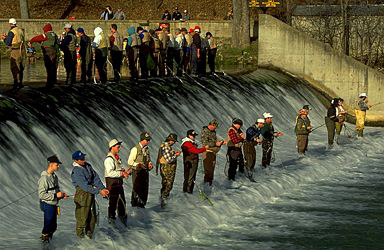
Opening day at the dam, Bennett Spring State Park, MissouriHere, sure-footed anglers inch out along the top and bottom of the dam appearing as (to me anyway) a chorus line. At any moment…maybe following the landing of a prized lunker…I have expected the line to link arms and in sequence give a high kick. That would be a shot.

Of all the years I have covered opening day for trout fishing in Missouri, one particular shot also taken at Bennett Spring seemed to capture an unusual amount of attention from editors across the country.

I knew I had something a little different from years past when the ordinarily blase photo editor on the other end of the phone in New York said, “Oh, my gosh! Look at those…fishermen. All jammed together like that!” The next day the photo appeared above the fold on the front page of USA TODAY and later that week inside TIME Magazine and scores of other newspapers and publications.
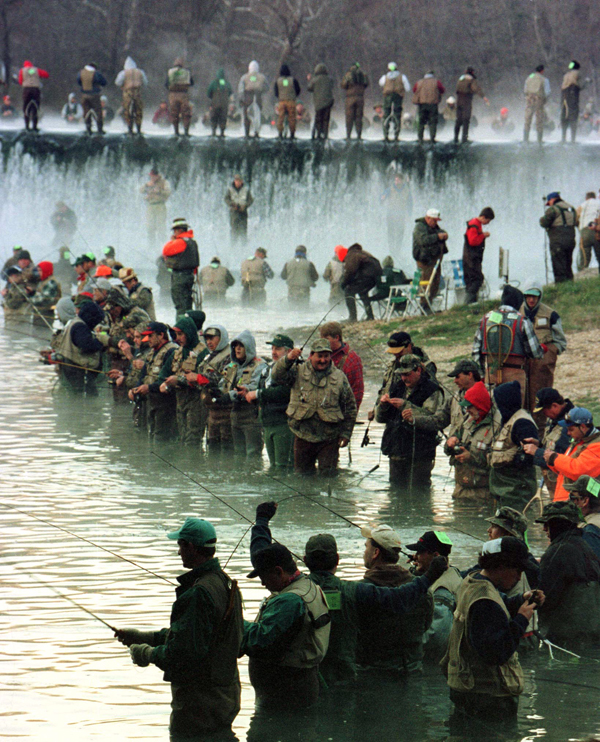
This shot caught the eye of editors around the country and ended up on the front page of USA TODAY.

The scene is the same every year. A cliché. Why did this shot seem to grab attention? I forget that just because we who live here and have seen this scene many times doesn’t mean everyone has seen it. So, maybe the best way to approach a cliché is straight on.

In this case, “straight on” meant a short trek down the river away from the “traditional” photo spots and muscling my way in among the fishermen with my tripod sitting in the water and shooting back towards the dam. I now leave briefly from my rule of not talking equipment. I used a Canon 35-350mm lens zoomed out to about 300mm. That certainly helped to compress the elements of the photo together and give the anglers that feeling of closeness. But, it also allowed me to shoot under a bridge that would have obstructed much of the view with a shorter lens.

I wonder why I hadn’t seen the shot years before. Sometimes you just have to force your eyes out of the “normal” mode even if it is cold, your fingers are aching and the fishermen are glaring at you for taking up prime real estate along the riverbank.

John S. Stewart