
Fishing with “W”

FAMOUS PEOPLE, Fishing with "W"

Thirteen months before the 2000 election, when George W. Bush eked out a very contested victory over Al Gore, the governor made a stop in the Ozarks in support of Roy Blunt who was running for the 7th district house seat.
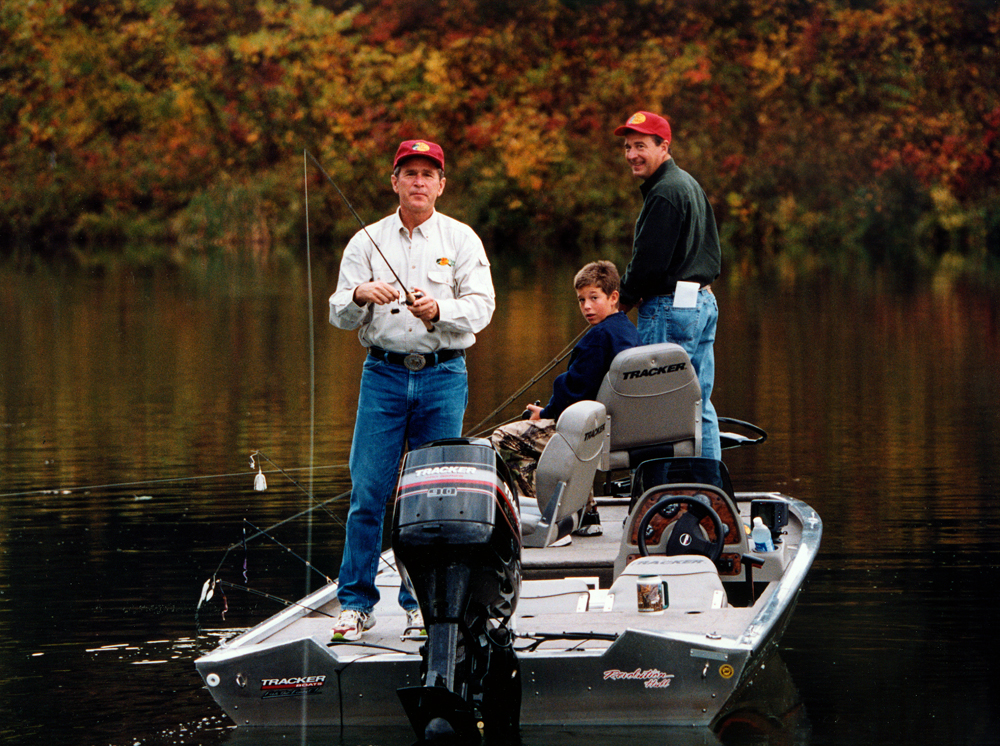
George W. Bush fishing in Missouri before the 2000 election

George Bush fishes with Bass Pro Shops owner, Johnny Morris and his son in October 2000 three weeks before he is elected President. (Photo copyrighted by John S. Stewart/LEFTeyeSTORIES)

He was also planning a brief rest and relaxation period away from the campaign and media as the house guest of Bass Pro Shops owner, Johnny Morris. The night before they were to go fishing together, I got a call from an Associated Press reporter telling me he had been in contact with a Bush aide and the governor had agreed to allow one still photographer to come along but no reporters or video cameras. They would need my social security number for a quick background check and since there wasn’t time to get a “Letter of Introduction” for me to present to the Secret Service, I would need to bring as much identification as I had.

Before the sun was up the next morning, I made my way to the private lake east of Springfield. When I turned off the asphalt road to the private gravel drive, two men in dark polo shirts and sport coats stepped to the center of the drive and motioned me to stop. One stepped to my window and asked, “Could we help you?”

They never identified themselves as Secret Service agents but the ear pieces and slight bulge under their coats were pretty good indications I was in the right place.

I explained my early morning mission and he seemed to have no knowledge of it and asked if I had any identification. I handed him my driver’s license, media photo ID tag, and my passport. The two stepped back and looked at each one turning them over a couple of times and spoke in low inaudible tones.

Thinking there was some SNAFU, I started to explain further who made the arrangements when one of the men looked up and said, “We know. We’ve been expecting you. Did you have any trouble finding the place?”

Relieved, I quickly shot back, “Oh, no. Not at all.” There was about ten seconds of silence while I rethought my answer and amended it to, “Well, actually I went about a quarter-mile too far and had to turn around and come back.” Still looking at my photo IDs and without looking up, the agent replied, “Yeah, we saw you.” I’m now thinking to myself, ‘You’re off to a great start. You fibbed to a Secret Service agent and he knows it.’

“Ok, you’re fine. We just need you to step out of the car and place your camera bag on the hood.” In lieu of an electronic metal detector or wand, I was treated to an old-fashioned pat down by hand while the other agent looked through my camera bag.  No big deal and not nearly as invasive as today’s airport TSA pat downs.

“Ok, one of the Governor’s aides is waiting for you down by the dock. He will direct you and the Governor will be along shortly.”

The aide and I would be in a tiny…and I mean tiny… jon boat that was barely 10 feet long and had two bench seats wide enough for one person each. The aide would be at the helm manning the 8 h.p. motor. The second boat was a 16 foot open aluminum fishing boat. It contained three Secret Service agents (one drove) and Morris’ brother-in-law who was along as Morris’ photographer. The third boat was a first class bass boat complete with pedestal deck chairs. It contained Governor Bush, Johnny Morris and Morris’ son.

I was told my time on the trip would be limited to about 15 minutes. The Governor wanted this to be a truly private affair and there would be no questions or interview. Conditions were not great for great shots but that’s what makes photojournalism what it is. You deal with what you have in front of you. It was a beautiful crisp fall morning but the sun hadn’t been up long so light readings were still pretty low meaning slow shutter speeds for the next 3o minutes or so even using ISO 400 film. I was going to be in a less than rock solid boat so a tripod or monopod really wouldn’t help.

I stepped onto the dock and it seemed like all eyes from boat #2 were on me as I approached Governor Bush who was bent over closing up his tackle box. I introduced myself and he stood up and introduced himself and said in that GWB twang, “Boy, it’s pretty early in the morning to come out just to take some pictures.”

Everyone piled into their assigned boat and the bass boat with Bush in it backed out of the boat slip. Morris was at the helm and stopped about 20 feet from the dock and said, “Why don’t throw one out here and see if you get any bites?”

I thought this would be a better opportunity to shoot from the dock and not the boat I was in that would not be still no matter how still I was. So I scrambled back onto the dock as did the governor’s aide and as did two of the Secret Service agents. The dock was one of those with a metal roof but not the heavy commercial docks that feel firm under foot. When anyone walked, the dock gave way a little making it only a little more stable than the boat I just left.

I braced myself and camera against one of the uprights closest to where the Bush boat was. Behind me at the front of the boat slip the two agents continued to move and reposition themselves making the dock sway under me. I looked back at the aide and said, “Can you…?” nodding at the agents. He said, “Oh, sure, sure! Hey guys…can you be still?” I looked back to my left and saw two United States Secret Service field agents attached to a Presidential candidate frozen like mannequins at my request. Ok, it was a bit of a heady moment for about two seconds.

I was asking myself if he was doing this for my benefit which was a little unsettling but later learned that the bass they were going after often hang around docks and brush piles.

Bush got off his first cast I assume without any practice casts earlier because the lure landed on the roof of the dock shattering the early morning quiet only the way hard plastic on sheet metal can. His reaction and that of the others in his boat is what you see in the photo.

His second cast was better placed but still way long. The heavy bass lure designed to disturb the water as much as possible as it plows its way back to the rod remained airborne until it landed squarely on the head of one of the frozen secret service agents on the dock.

There was an audible grunt from behind me and a very concerned look from Bush who said, “Oh…you OK?” The agent dutifully replied, “Yes sir. I’m fine.”

There were no bass to be had by the dock so the flotilla of bass boat, photo boat and gun boat motored across the lake where there was a brushy shore and the casting started again. My 15 minute photo-op turned into 20 and then 25 and Bush finally said, “Well, I really would like to pull one in while you’re here but that may not happen.”

That must have been a cue for his aide because the aide indicated it was time for us to go back. No sooner had we pulled alongside the dock than out in the water across the lake we heard splashing and excited voices. We sat and listened and tried to see across the  100 yards or so. And then, when the quiet returned there came that unmistakable Texas twang, “Hey photographer. I got one.”

Oh, well.

John S. Stewart

“Wasteland” in the Ozarks

"Wasteland" in the Ozarks, PHOTO STORIES, THE OZARKS

The 2010 Oscar nominated documentary film, “Wasteland” profiles a few of the estimated 250,000 people in Brazil who make their living reusing and recycling the trash the rest of the population generates.

The Ozarks has its own 1976 version of “Wasteland”.

I lay in bed listening to the nearby early summer nighttime chirping of crickets and tree frogs. The more distant sounds of highway traffic and dogs barking completed the nocturnal ambient noise drifting through the open windows of my new non air conditioned abode in Salem, Missouri.
So much for nostalgic sensory memories.

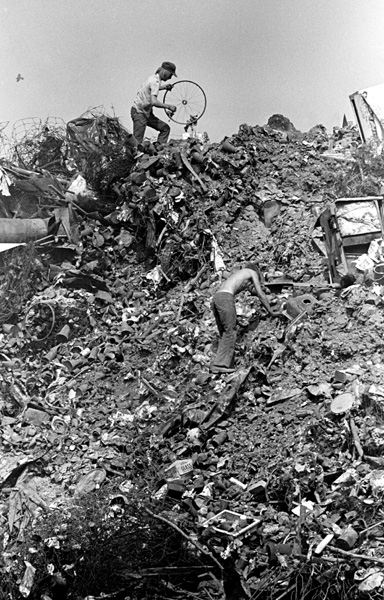
Humans and animals pick through pick through garbage at an open burn waste dump in the rural Ozarks-1976.

An old woman and a dog look for something usable or edible in an open burn waste dump in the rural Ozarks in 1976. (Copyright John S. Stewart/LEFTeyeSTORIES.com)

What really got my attention this night was the smell drifting through the window screens; a burning smell. This smell wasn’t the sweet smell of wood smoke on autumn days but the acrid smell of stuff burning that will burn but wasn’t made with the intention to burn it. Things like household products and the stuff we need or think we need to live each day.

The next afternoon on my way home from work, I made it a mission to follow my nose to the source of the offending odors. I found it at the end of a gravel road across the highway from where I lived.

At the end of the road the terrain dropped off to a sloping hillside until it reached flat ground again 30 or 40 feet below. At the top of the hill garbage trucks, pickup trucks and even cars would back up and empty their contents down the side of the hill.

An Ozarks' Version of "Wasteland"

Two boys pick through refuse at an open burn waste dump in the Ozarks-1976. (Copyright John S. Stewart/LEFTeyeSTORIES.com)

Within a few minutes, three or four or a half-dozen people would gather around the fresh drop and begin picking through it. Men, women, children and the old all made up the group of people who gathered daily to find something they needed or could use that others didn’t need or couldn’t use.

I photographed some of the pickers and approached a few but found none anxious to talk. Most turned and walked away when they saw my camera. Whether the shame of such pursuit is self-imposed or handed down from society, it is there regardless.

An attendant told me most of the pickers came late in the afternoon when most of the trash was dumped. Then in the early evening he would set fire to what would burn reducing the volume on the hillside.

The resulting piece was offered to the editor as a photo page with little copy since I wasn’t able to really talk to the subjects. If I remember correctly, I likened the experience to walking into Dante’s Inferno and presented it as a window the people of the town could look through and see a part of their town most of them had never seen.

I’m not sure if it was really appreciated but I had found the source of my sleepless nights; the nocturnal smells drifting past my open bedroom window and now visions of people picking through garbage.

  John S. Stewart

A Biker’s Funeral

A Biker's Funeral, PHOTO STORIES, THE OZARKS

“Well, you sure have some pretty rough, scruffy lookin’ friends”, the office secretary shot across her desk as I came through the door of the small Missouri town newspaper where I worked in 1978.

Booger Red's friends escort him to his final resting place.

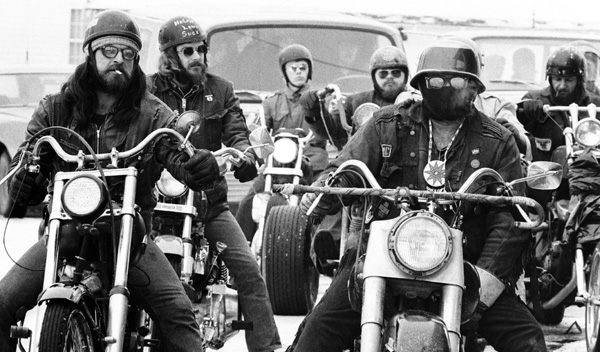
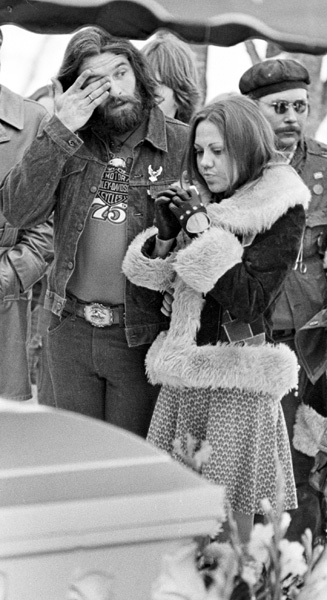
Friends of “Booger Red” line up for the funeral procession that will take him to his final resting place. “Hagen” is at right in the German helmet. (Photo copyrighted by John S. Stewart/LEFTeyeSTORIES)

Twenty minutes earlier, the office was full of a dozen or so leather jacketed tattooed (tattoos weren’t so mainstream then) motorcycle gang members wanting to see me. Their friend and fellow gang member, “Booger Red” had been ‘murdered’ and now they were going to bury him with a proper biker’s funeral.

Some weeks earlier I had taken a photo of a local teenaged boy being airlifted to a Shriners’ Burn Hospital after he ignited himself  with gasoline while filling up his motorcycle. His father, “Hagen” was the gang’s leader and wanted me to photograph their friend’s funeral. I was to go to his house where the gang had gathered and we would talk about it. O…K….sure why not?

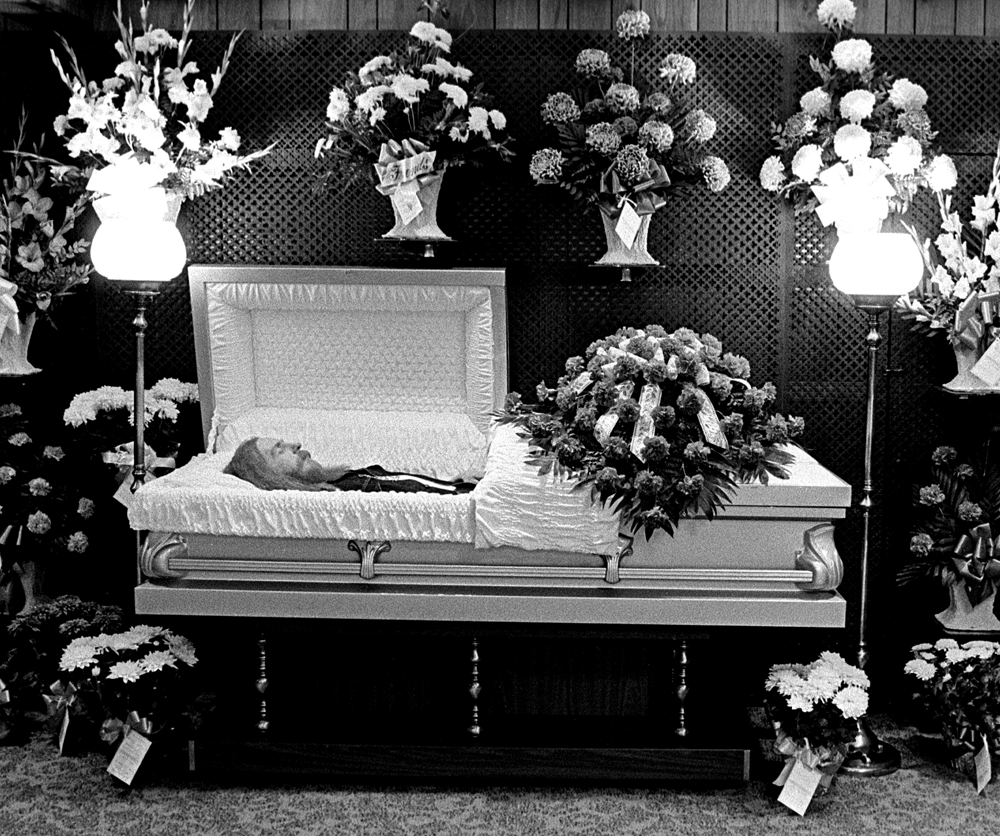
Motorcycle gang member "Booger Red" at the funeral home the night before the biker's funeral.

Motorcycle gang member “Booger Red” at the funeral home the night before his biker funeral. (Photo Copyrighted by John S. Stewart/LEFTeyeSTORIES)

Booger Red got his name from his flaming red hair and by his friends’ own description, he was a “booger”…mean. He was killed by a single gunshot to his chest through a screen door after he threatened the person inside with an ax during a drug deal gone bad. I was not going to argue with his friends whether he was “murdered” or killed in self-defense.

I arrived at Hagen’s house and was greeted in a quiet way like anyone arriving at a wake. The group, dressed in leathers accented with chains and images of skulls and fire was somber.

Years later while visiting an Amish household I would remember the

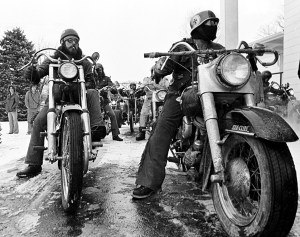
Mounted on their hogs, friends of Booger Red line up outside the funeral home.

Mounted on their hogs, friends of Booger Red line up outside the funeral home. (Photo Copyrighted by John S. Stewart/LEFTeyeSTORIES)

similarities in the two experiences. None of the men, except the leader, would talk to me. When I made eye contact with the female members of the group, they would look away.

Hagen and I sat a table and he thanked me for coming and then outlined the next day’s funeral activities. There would be a traditional funeral at the local funeral home for “Booger’s” immediate family. Yes, Booger actually had a mother and siblings. After that, it was the gang’s show. There would be a motorcycle escort the fifteen miles to the grave site out in the country and graveside services.

Hagen went on to explain that after that at most biker funerals,  everyone stands around and drinks beer and puts their empties into the casket. Charming. That would not happen for Booger Red. The celebration would wait until that evening when there would be dancing and drinking ON his grave. There would also be a couple of vans parked there with a girl in each …there for the taking. Thanks but no thanks.

At this point a whirl wind of journalist ethics, morals and questions began spinning in my head. Do I even continue pursuing this story? It was unusual to have been granted such access without a great deal of rapport but was my presence as a journalist guiding the behavior of the subjects?

The day of the funeral was cold, rainy with a little sleet and snow mixed in. The procession would be stopped several times as biker after biker

Mourners at fellow motorcycle gang member, Booger Red's funeral.

Mourners at fellow motorcycle gang member, Booger Red’s funeral. (Photo Copyrighted by John S. Stewart/LEFTeyeSTORIES)

slid out on the slick pavement ending up on the ground in front of the hearse.

I didn’t go to the evening activities after the graveside services. Instead, I developed film, printed photos and worked on a full-page layout to present to the editor the next day. He went for it and it would run in that afternoon’s paper. Before the presses started to roll, one of the pressmen asked me, “How many extra copies do you want to run?” “Extras?” I replied. “That’s not my decision but I don’t think we’ll need any.” He assured me there would be a need and by six o’clock that evening he was pulling early run rejects (those first copies that come off the press before they have the ink adjusted correctly) out of the trash to put out in the now sold out boxes on the street.

The next morning the office secretary that had remarked about my rough-looking friends locked her eyes on me as I came in and said, “Do you know how many phone messages I have listened to this morning about your biker funeral story and I’m not even to the end of the tape?”

The break was about 50-50. Half  the readers loved it and half hated it

but everybody wanted to read about it. Some saw it as glorifying a seedy element of society and others were interested in getting a glimpse of a side they ordinarily would never see.

To me, that is why you do stories like this one.

John S. Stewart

Frozen Forms

Frozen Forms, QUICK SHOTS

This ballet on ice was actually shot by my father. I say that because he is the one holding the flash and the one who fired it, albeit on my command.

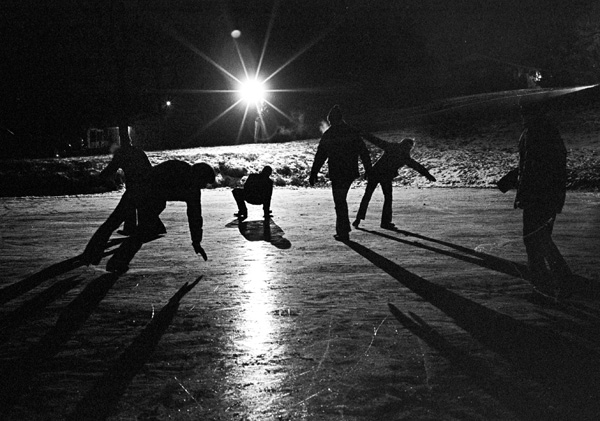
Driving around one winter evening in 1976, I came upon the lake in the subdivision that was a favorite for ice skating in the winter. This evening the skaters were mostly without skates; just running and sliding arms flailing  in the air. It had all the grace of a poorly choreographed ballet with jerky movements.

Skaters on a frozen pond are “frozen” with a handheld flash. (Copyright John S. Stewart)

I thought in stop action it might have a more aesthetically appealing look and make a stand alone weather shot for one of the wire services.

Enlisting the help of dad, I instructed him to stand on the bank of the lake with one of my Honeywell strobes  keeping it pointed at me while I slid out among the skaters.  I set the camera on a tripod, stopped down to about f8 or f11 and opened the shutter with the long gone “B” or “bulb” setting.

I then waited for “the moment” to flash a small penlight flashlight sending my father his cue to fire the flash.  After several times of repeating this anticipating the delay between the cue and the flash and replaying the frozen image in my mind, I was confident I had something useful on film.

Getting this shot today would be a little easier using a digital camera with the ability to check each shot and a strobe  fired using a radio frequency remote. But then, I would have missed out on some quality time with Dad.

John S. Stewart

MANHUNT

MANHUNT...but without the Hollywood ending, PHOTO STORIES, THE OZARKS

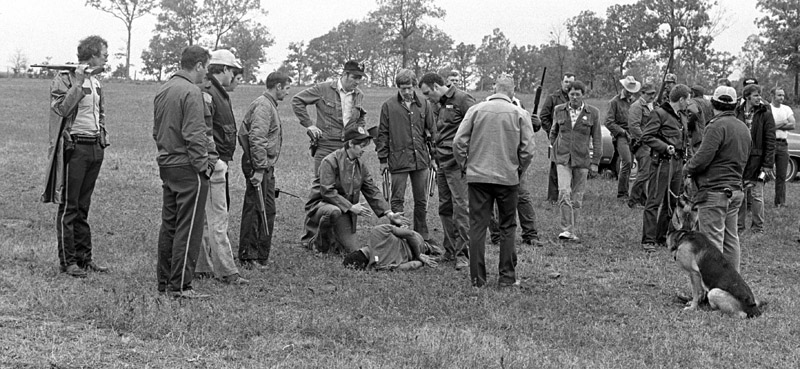
Initially, the photos appear to portray a scene from a movie about mid-20th century manhunt in the rural America where racist white officers and their dogs pursue, shoot, and then celebrate the capture of a young Black man.

This was not the case here. I know. I was there. This is where proper words have to fill in the blanks of those 1000 word essays that photos are supposed to deliver.

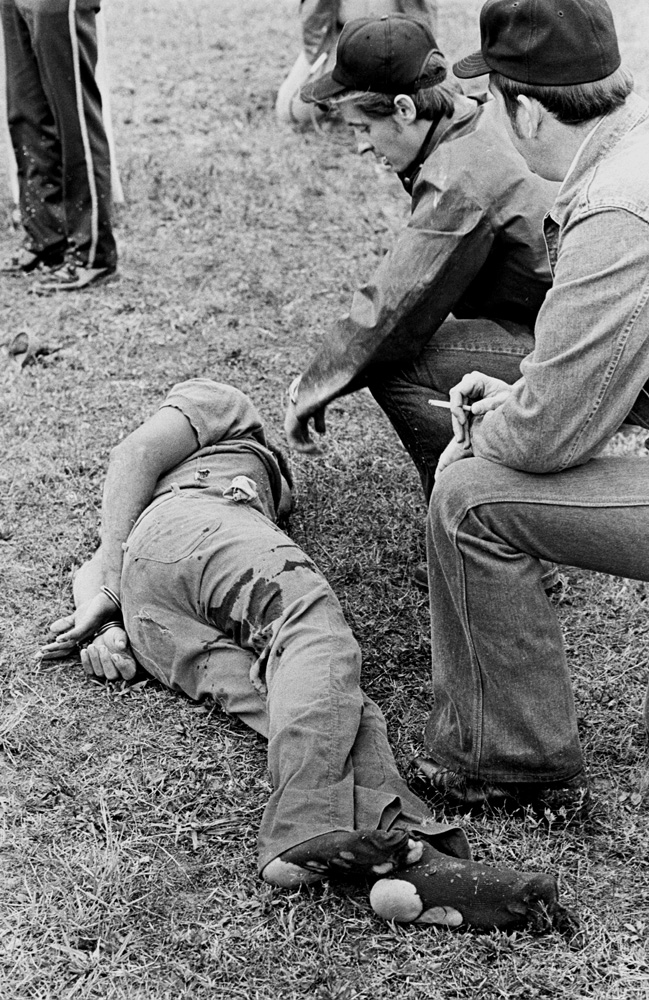
Minutes after firing a single rifle shot that ended the flight of fugitive Willie Joe Taylor, the sharpshooter kneels at his side.

Minutes after firing a single rifle shot that ended the 3-day flight of fugitive Willie H. Taylor, the sharpshooter kneels at his side.

In October 1977, Oklahoma murder suspect and fugitive Willie H. Taylor was taken in to custody in Pulaski County, Missouri. During questioning, he grabbed a deputy’s gun, wounded the deputy, and fled in a stolen truck.

Two days later, Taylor ditched the truck in Camden County and continued his escape on foot through the rugged Ozarks countryside. The ex-marine had his shoes removed during his arrest, but that didn’t seem to slow him down.

Sightings of Taylor by residents of the hill country were many. Doors were locked and guns kept close by as lawmen pursued, but always  just one step behind. According to several reports, when confronted by residents checking outbuildings, Taylor would growl and flee instead of speaking.

On the third day, I got word through an informed source that “today could be the day they get him.” The focus of the manhunt was now in a wooded area in Camden County. Many law enforcement vehicles and officers, including the FBI, were parked along the road near the command center. Amazingly, there were only two TV crews and one radio station there. I was the only still photographer.

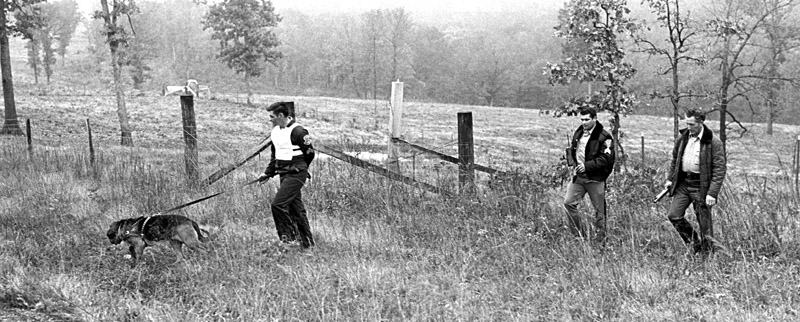
Dogs track fugitive Willie Joe Taylor over the rugged Ozarks' terrain in south central Missouri.

Dogs track fugitive Willie H. Taylor over the rugged Ozarks’ terrain in south central Missouri.

Events like this were a lot less formal in 1977 than they are today. Maps were spread out across the trunk of a patrol car and if you weren’t too intrusive, you could listen in on the discussion. Today those conversations are locked inside a mobile command unit van and media updates are issued regularly.

On this day, law enforcement officers even shared their hot coffee in Styrofoam cups to fend off the icy drizzle that made everyone all the more hopeful for a quick end to the manhunt. Within 30 minutes of my arrival, that hope came as several more vehicles arrived loaded with police tracking dogs from Indiana and Ohio. They happened to be training at a police K-9 school 70 miles away in Strafford, Missouri.

Until now, one or two privately owned “bloodhounds” had been used without success. Their primary “day jobs” were running raccoons up trees during those fabled Ozarks coon hunts and keeping their owners warm on cold winter nights. The task exceeded their abilities.

The newly arrived training school dogs were let out of their cars. Handlers were briefed at the back of a squad car. Then, disappearing over a nearby ridge, we began hearing the rapid chorus of barks that seemed to say, “we’re on to him.”

No one spoke. We couldn’t see what was happening on the other side of the ridge other than what was conjured up in our minds. The sound of the dogs’ excitement moved across the vista in front of us as everyone’s head panned right to left.

And then, muffled by the damp terrain of the ridge, boom…boom, boom, boom, boom…………………….boom.

Still, no one spoke. Coffee cups dropped to the ground and a rush to the cars followed. Lawmen and media drove a short distance up the road until we came to a drive with a closed gate where we left the cars to continue on foot. We ran past a house whose occupants stood watching wide-eyed and mouths hanging open as we scrambled over their barbed wire fence and continued up the hill.

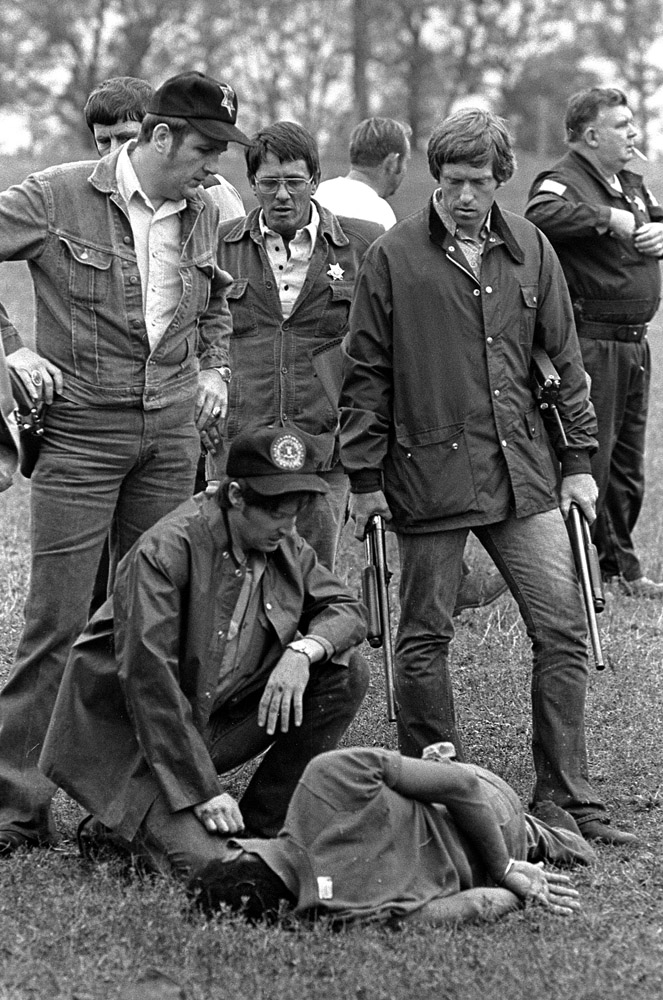
A 3-day manhunt for fugitive Willie Joe Taylor ended with Taylor lying on the ground shot and his shooter kneeling beside him surrounded by a dozen or more lawmen.

The manhunt for fugitive Willie H. Taylor ended with Taylor lying on the ground shot and surrounded by law officers.

At the top of the hill, I stopped to click off a few shots of what I saw in the field in front of me. Lawmen surrounded a figure lying on the ground with another figure kneeling beside him. We learned later the first shots we heard were gunshots fired into the air, attempting to get Taylor to stop after the dogs had flushed him out of the woods. Officers also yelled at Taylor from across the field to stop. The dogs remained on their leashes, unlike some movie depictions.

When he didn’t stop, the last shot was fired by a young Missouri Water Safety officer, Gary Barclay. The sharpshooter who took time to get into a sitting position on the ground to improve his aim. Using the scope atop his high-powered rifle, Barclay took aim at Taylor’s legs. A single shot shattered Taylor’s femur, dropping him to ground and rendering him unconscious.

The Missouri Water Patrol sharpshooter (center) kneels at a fugitive's side minutes after felling him with a single shot from across a field.

Missouri Water Safety Officer Gary Barclay (center), kneels at the fugitive’s side minutes after felling him with a single shot in his leg. Taylor’s torn socks are from his shoeless escape into the Ozarks’ countryside.

I ran up to the scene and dropped to my knees a few yards from Taylor’s feet. I remember seeing the scene in front of me, but being so out of breath, I worried I wouldn’t be able to hold the camera still enough to record it on film.

Taylor’s socks were in shreds from three days on the run without shoes. Kneeling beside him was the Missouri Water Safety officer, Gary Barclay, who shot him. This was the “non-movie script” ending. Barclay was emotionally drained, if not distraught.

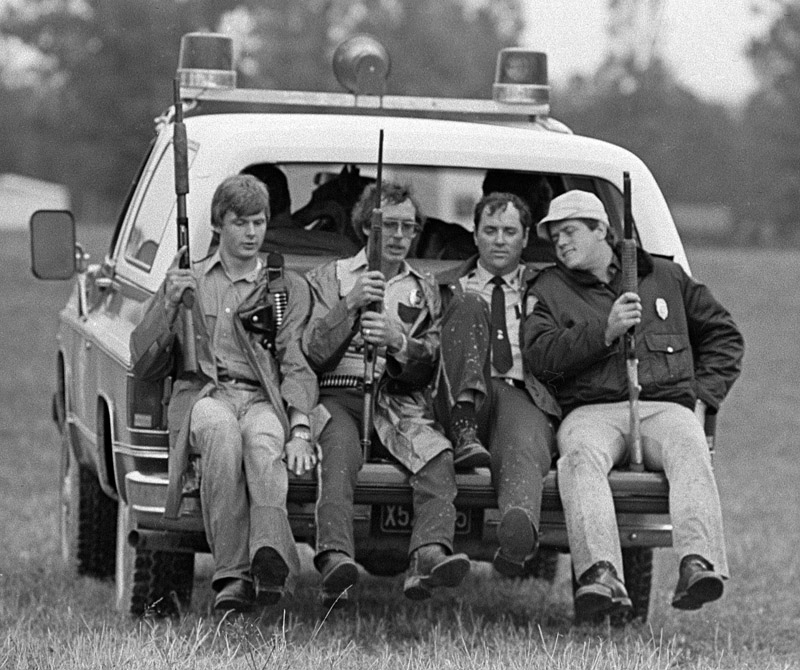
Lawmen catch a ride from the field where Willie Joe Taylor fell.

Lawmen catch a ride from the field where Willie H. Taylor fell.

Other officers, older and more experienced, put their hands on his shoulder as if to comfort rather than congratulate. The atmosphere was somber as they waited for paramedics to arrive. Few, if any, of them had felt what he was feeling now.

Even though Taylor will survive, the emotional trauma the officer felt ran deep. No amount of hunting squirrels and deer that honed his skills as an expert marksman could prepare him for shooting another human, no matter what that human had done. That’s the part you don’t get in the movies.

John S. Stewart